Sex later in life (60+): how to keep intimacy enjoyable, playful and full of desire as you grow older
The Violet Empress editorial team
The short answer
Sex doesn't stop at sixty: seven in ten Dutch people between 55 and 65 still make love, more than a quarter of those over 75 do, and that last share is growing. What changes is the pace: slower, gentler and more attentive, and many couples actually find that better.
Less desire: later in life, desire usually arrives during lovemaking, not before it. So simply start by touching; this is how it works.
Dry or sensitive: a good water-based lubricant solves most of it. Our recommendation is Hydra+; if there is pain, read what your body is asking for.
An erection that no longer comes by itself: a cock ring keeps it firmer, and with the Pulse Solo Essential he can enjoy himself even without an erect penis.
The calendar says nothing about what is still possible in bed.
Sex changes as you get older, but it certainly doesn't disappear. On the contrary: for many people over 60, intimacy actually becomes richer, calmer, more sensual and more connected. Less pressure to perform, more time, more attention for each other and often more self-confidence too give sexuality later in life a charm all of its own.
And let's not forget: making love regularly is good not only for your mind but also for your body. It keeps you energetic, supports your health and strengthens the bond with your partner. It is the key to vitality, joy and connection. So keep fantasising, laughing, playing and experimenting together. For a lifetime of passionate love.
Signpost
Where would you like to start?
What is going on for you? Choose below and you will see straight away where to go: on this page, in one of our other blogs, or in the shop.
Choose a box and the route will appear.
How many people your age still make love, and up to what age?
The meter: choose your age and see the share who had sex in the past year, men and women separately.
Six positions with an illustration, each with the reason why it spares the joints and a cushion or aid that goes with it. Spooning, side by side, on the edge of the bed, with a wedge cushion, standing and leaning, and her on top.
Readers' experiences: including Ans, who felt real desire for the first time at 63, and Els and Hans, both after a loss.
What will help you?
Five things that most often help people over 60: lubricant and a moisturiser, a ring, a cushion and a toy that works without an erection. The guide further down helps you choose, in two taps.
Our best-selling lubricant: a pump bottle, stays slippery for a long time, is not sticky and can be used with any toy and any condom. From our own brand House of Delight.
A soft, super-stretchy ring that keeps the erection firm for longer. The simplest first step when it no longer stays by itself.
The masturbator that also works without a hard penis: pulsating waves instead of vibrations, for him alone or together.
A moisturiser for daily use or every other day: keeps the mucous membranes supple, even when you are not making love. The lubricant is then an extra.
Take a look at all aids for comfort.
Your route is below. You can always choose another box.
A compact wedge cushion that lifts the pelvis or back just enough; the difference between a position that hurts and one that feels good.
Sex later in life: myths and reality
Many people assume that older adults hardly feel like having sex any more. But research by the Dutch national statistics office, Statistics Netherlands (CBS), paints a more nuanced picture. How many older people have sex? Among 55 to 65-year-olds, around 70 % are sexually active, among 65 to 75-year-olds about 53 %, and among those over 75 the share rose from 16 % in 2014 to 27 % in 2022.
53%of Dutch people aged 65 to 75 had sex in the past year; among 55 to 65-year-olds it was 70 percent.
27%of people over 75 had sex in the past year, and that share is growing: in 2014 it was still 16 percent.
41%of people over 75 who live with a partner still made love in the past year. What usually comes to an end is not the sex, but the partner.
3 in 10men have at some point gone through a period with a disappointing erection; for one in twenty-five it is a genuine disorder.
It is also striking that men at an older age are slightly more often sexually active than women. That difference has several social and demographic causes. Older women are more often single, partly because men tend to be the older partner in relationships and partly because women have a higher life expectancy. As a result, at an older age there are simply more women who no longer have (or never had) a partner, which naturally affects their sex life.
If, after a divorce or the death of a partner, someone new does cross your path, you are in fact starting over. How that goes, in bed as well, you can read in dating and making love again after a divorce or loss.
Up to what age do people have sex?
For as long as they want to and are able to; there is no age at which it stops. Of people over 75, 27 percent still had sex in the past year, and of those over 75 who live with a partner, as many as 41 percent. What usually comes to an end is not the sex, but the partner: people who live alone make love far less at that age. See for yourself how it looks for your age in the gauge further down.
How often do people over 60 have sex?
CBS only records whether someone had sex in the past year, not how often. Rutgers, the Dutch centre of expertise on sexuality, asked more precisely: of people over 70, more than four in ten had sex with a partner in the past six months, and those who make love rate their sex life a 7 out of 10 on average, just like younger people. How often exactly varies enormously: once a week or once a month both occur, and both are normal. The only number that counts is whether you are both happy with it.
Sexuality and intimacy in older people: so what does change?
Not the need for touch, warmth and closeness; that lasts well into old age. What changes is the body: slower to become aroused, drier, an erection that doesn't always come, and more often an illness or a medication that plays a part. And the circumstances: a partner who falls ill or passes away, or, on the contrary, a new love after a divorce or a loss. How that works in practice is told by Margot and Henry (65-plus) and Henk and Mieke; and sex after 70 has a blog of its own.
These figures clearly show that sexuality can be a lifelong part of wellbeing and health. Talking about sex later in life is therefore not a luxury, but a form of self-care.
Four myths, and what is actually true
Myth 1
Sex stops after 60.
What is actually true
Data from CBS show that a large proportion of 55 to 75-year-olds remain sexually active. Frequency does decline gradually with age, which makes sense given changes in health, hormones and relationship circumstances. But sexuality does not stop. In fact, people over 75 have been having sex more often over the past ten years, which shows that intimacy and desire endure, even if their form sometimes changes.
Myth 2
Women lose their libido completely after the menopause.
What is actually true
The menopause changes the body in some respects, but that doesn't mean desire disappears. The CBS figures show that a majority of women between 55 and 75 still have sex, and that whether someone over 55 still makes love depends mainly on whether they have a partner, their health and emotional connection. Many women find that their libido returns or remains stable once complaints such as dryness, pain or stress are addressed. Hormones do play a role, but they are rarely the only factor.
Myth 3
Older men can no longer have satisfying sex.
What is actually true
Changes in erections are normal, but there are plenty of solutions. From cock rings to penis pumps and simple adjustments that take away a lot of pressure.
Myth 4
Sex later in life is unhealthy.
What is actually true
There is no evidence that sex after 60 is harmful for healthy adults. On the contrary: several studies have found a link between lovemaking and better perceived health, more joy in life and less stress (source).
Getting older changes your body, but it also changes the way you experience intimacy. Sex often becomes less rushed and more sensual, with more attention for the moment.
More time, less pressure, more freedom
On top of that, the children have most likely left home and work and career have taken a different place in life, which leaves extra time and room for spontaneous, unhurried lovemaking. These years, with more time and fewer distractions, can therefore be a time of sexual creativity and passion.
Sex is more than penetration (and that often makes it better)
As you get older, the focus often shifts from performance to experience. And that actually works entirely in your favour. Many couples discover that intimacy becomes richer and more intense when there is less emphasis on penetration and more on:
touch
gentle massage
kissing
sensuality
sharing fantasies
romantic play
foreplay that is allowed to last (much) longer
The loveliest thing about sex later in life is often the discovery that intimacy is much broader than penetration alone. Sensuality, tenderness, slow touch and emotional connection become more important than speed or performance.
Health benefits of sex after 60
Although sex later in life is often seen as something that is 'still possible', we sometimes forget that it is genuinely good for body and mind. Intimacy activates several systems in the body that contribute to vitality, relaxation and a sense of connection.
A cocktail of feel-good hormones
During sex, various hormones are released that make you feel good not only in the moment, but for hours afterwards too.
Endorphins help to ease pain and give a mild, natural euphoria. Many people experience less tension, fewer headaches or less stiffness after sex.
Dopamine brings a contented, relaxed feeling that helps you let go of stress.
Oxytocin, also known as the bonding or cuddle hormone, strengthens the sense of intimacy and trust between partners.
Prolactin rises after an orgasm and gives that calm, satisfied feeling that helps the body recover.
This combination means that sex is not only enjoyable, but also offers a natural way to regulate stress and find emotional calm.
Lovely skin, better circulation
During arousal and lovemaking, your heart beats a little faster and blood flow to your skin increases. That gives a natural, healthy glow. Better blood circulation makes the skin look fuller and healthier and supplies it with more oxygen.
Cardiovascular benefits
People who make love regularly have a healthier heart on average; this has been measured in adults up to the age of sixty. And research in Amsterdam among older people shows that those who enjoy sex and consider it important live somewhat longer on average (source). It does not prove that sex improves the heart, because healthy people also make love more often. But it does show that lovemaking is no danger to a healthy heart, if anything the opposite.
Intimacy as a mental health boost
Intimate contact not only promotes physical health, it also strengthens self-confidence. People who feel desired, touched and connected experience less loneliness, more zest for life, a better mood and a stronger sense of connection with their partner. So sex is not just enjoyable, it is also a source of emotional resilience later in life.
What happens to your body as you get older?
Your body naturally changes as you get older. That is not a problem, but something to understand and, above all, something you can learn to go along with. Many of these changes are completely normal and easy to manage with small adjustments, aids and open communication.
Changes in women
During the menopause, oestrogen production drops, which can make the vagina drier and more sensitive. That does not have to limit your sex life, but it sometimes calls for a little more attention, time and gentleness. Common changes:
less natural lubrication
thinner vaginal walls, which can sometimes lead to sensitivity or mild pain
slower arousal
Fortunately, there are plenty of solutions. A good lubricant can work wonders, as can sensual massage or longer foreplay. Which lubricant suits dryness best is explained in our comparison for the menopause; if it also feels dry or burning during the day, a moisturiser such as JO Renew is a real help. If you experience pain during sex, it is worth taking a moment to consider what your body needs.
Libido in a woman of 60: what is normal?
Anything from wanting sex every week to rarely feeling the urge on your own. For many women, it is mainly the kind of desire that changes: less spontaneous, more a response to touch, warmth and time. Dryness, poor sleep, medication and a partner with erection problems dampen desire at least as often as the hormones themselves. What you can do about it is explained in boosting libido as a woman and no desire after the menopause.
Changes in men
Many men experience changes in the quality of their erection around and after 60. That is a natural consequence of ageing blood vessels and a shifting hormone balance. Common changes:
a slower or less firm erection
losing the erection more quickly during penetration
a longer recovery time
There are easy-to-use aids for both solo and couple play, such as cock rings, erection pumps and masturbators that reduce pressure and increase pleasure. If the erection consistently fails to appear, read solving erectile dysfunction and an erection without a pill. A masturbator that is genuinely made for this is the Pulse Solo Essential: not vibrations but pulsing waves, which you can feel even when the penis stays soft or only half hard.
Chronic conditions and their impact
Many people over 60 live with chronic conditions such as cardiovascular disease, diabetes, osteoarthritis or back problems, or an enlarged prostate, and that can of course affect your sex life. Think, for example, of less energy and stamina, reduced blood flow, sensitivity or pain, or limitations in posture and freedom of movement.
Moreover, having less or no sex is not necessarily a cause of poor health in men around 65, but sometimes a signal of underlying problems such as chronic conditions, depressive symptoms or erection problems. Three in ten men, of all ages, occasionally go through a period in which their erection disappoints; for one in twenty-five it is a genuine disorder. That difference is worth knowing before you put a label on yourself.
Sex is generally safe for healthy older people. If you take medication for your heart, blood pressure, prostate or diabetes, talk to your doctor if you experience new problems. Some medicines affect blood pressure, erection or libido; you can read which ones in side effects of medication on sexuality and take a look in your medicine cabinet.
Is sex safe with heart problems or diabetes?
Usually, yes. Making love takes about as much effort as climbing stairs; if you can do that without symptoms, you can usually make love too. After a heart attack, your cardiologist or cardiac rehabilitation team will tell you when it is safe again; how to get started again is explained in your sex life after a heart attack. With diabetes, it is mainly dryness and erections that need attention. If you get chest pain, are very short of breath or are in doubt, talk to your GP before you continue; that is nothing to be ashamed of, it is simply sensible for your heart.
With illustrations
Positions that spare your knees, hips and back
A stiff knee, a worn hip or a back that no longer puts up with everything: for many couples, that is the real reason they make love less often, not a lack of desire. These six positions ask little of your joints and a lot of each other. In the illustrations she is dark purple and he is lilac. If sex is painful, also read our positions for pain during sex; all the cushions can be found under sex cushions.
Position 1
Spooning
spares knees and back
no weight on each other
works with a partial erection too
How to do it. You both lie on your side, him behind you, like two spoons in a drawer. Draw your upper knee up a little so he can reach you more easily. His hand is free for your breasts or your clitoris, and you can take his hand and show him what you want.
Why it is gentle. Nobody carries any weight, nobody has to kneel and your back stays straight. Penetration is shallow, which is pleasant if you experience dryness or sensitivity, and a penis that is not fully erect is no obstacle here.
Nice to have. A pump of Hydra+ lubricant within reach; in this position a little extra glide does half the work.
Position 2
Side by side, face to face
spares hips and back
kissing and eye contact
a gentle pace
How to do it. Both of you lie on your side, facing each other. You lay your upper leg over his hip and he moves a little closer to you. The pace is naturally slow; this is a position for kissing and talking.
Why it is gentle. There is no pressure on the hips and nobody has to push themselves up. If you can no longer spend long on your back or your knees, this one will suit you best.
Nice to have. A small toy between you, such as the Je Joue Mimi, fits perfectly in the space between your bellies.
Position 3
On the edge of the bed
spares his knees and her back
feet on the floor
she is in control
How to do it. He sits on the edge of the bed with his feet on the floor, and you sit on his lap with your back to him, your feet on the floor too. You set the pace and depth with your legs; his hands are free.
Why it is gentle. Sitting is easier on your knees and back than lying or kneeling. Because you both have the support of the floor, nobody has to strain to stay upright.
Nice to have. A cock ring keeps the erection firmer while you take things slowly; in a seated position that is often welcome.
Position 4
On your back, with a cushion under your hips
spares her back
less deep
he stands or kneels on a cushion
How to do it. You lie on your back with a wedge cushion under your pelvis, so that your hips are slightly raised and your knees stay relaxed and drawn up. He stands beside the bed if it is high enough; if he kneels, he does so with a cushion under his knees.
Why it is gentle. The cushion does the work your back would otherwise do: it keeps your pelvis at the right height without you having to tense up. The angle makes penetration less deep and the clitoris easier to reach.
Nice to have. The Liberator Jaz is the compact wedge cushion we recommend for this; the larger Wedge if you would like more lift. How to choose a cushion like this is explained in our guide to sex cushions.
Position 5
Standing, leaning on the bed
spares knees and hips
nobody lies down
works in the kitchen too
How to do it. You stand bent forward with your hands or forearms on the bed, the table or the kitchen counter, feet slightly apart. He stands behind you. The higher the surface you lean on, the straighter your back stays.
Why it is gentle. Standing and leaning costs your knees nothing and your hips very little; if you wake up stiff, you can often still manage this perfectly well. Because penetration can be deep, a slow start is wise.
Nice to have. If deep penetration feels sensitive, the soft Ohnut buffer rings limit the depth without you noticing they are there.
Position 6
Her on top, with a cushion behind his head
spares his back and knees
she sets the pace and depth
good with a fluctuating erection
How to do it. He lies on his back, with a cushion under his head and, if you like, one under his knees. You sit on top, upright or leaning slightly forward with your hands on his chest. You choose the angle, the depth and the pace.
Why it is gentle. He does not have to carry or hold anything. For you it is harder on the knees; a soft mattress or a cushion under your knees helps, and if your knees trouble you, the edge of the bed or the wedge cushion is the better choice.
Nice to have. If his erection comes and goes, the Pulse Duo is made for exactly this: a toy for couples that works even without an erect penis.
A cushion under the knees, head or pelvis makes almost any position easier. And whatever you choose: start slowly, and laugh if it does not work straight away. That is part of it.
Less desire, or a different kind: mental and relationship factors
Desire changes over the course of a lifetime. For some people it grows stronger, for others it becomes a little softer. That is normal. Libido is shaped by emotions, relationships, stress, health and life events. It says nothing about your worth, your attractiveness or your relationship.
Mental fatigue, stress and expectations
People often assume that the desire for sex should arise spontaneously, but as we get older that happens less and less on its own. Desire often only grows during intimacy, not before it. Stress, worries, poorer sleep or caring for a loved one can dampen desire, but they are no proof that you are done with sex.
Openness is crucial here. Many couples feel tension because they think they have to perform or live up to the expectations of years gone by. If this goes unspoken, and if people do not realise that it is perfectly normal, there is a real chance that performance anxiety and tension will throw a spanner in the works of your sex life. Never let it get that far.
The past, the quality of your relationship and emotional intimacy
Sex and emotional connection are closely intertwined. Unspoken disappointments, old wounds, experiences of loss or relationship dynamics can all affect desire. The reverse is also true: if you are in good shape psychologically, you are much less likely to run into a sexual problem.
Desire changes, but it rarely disappears completely
It is normal for desire to fluctuate. Sometimes less desire simply means your body needs a different kind of stimulation: more tenderness, a longer warm-up, other forms of touch, or simply rest.
What matters most is that you look together for what does work. Desire changes, but your connection can actually grow deeper.
How do you rekindle desire in a partner of 70?
Not with a pill and not with a surprise attack. At that age, desire rarely appears out of nowhere; it grows from touch that does not have to lead anywhere. So start small: a hand on the back while making coffee, a massage with no follow-up, a shower together, an evening without the television. And say out loud what you miss, without blame.
If a man withdraws, an erection that no longer comes on its own is often the unspoken reason. Let him know that what matters to you is him, not a hard penis, and that there are aids that make things easier; you will find them above. With a woman, deal with dryness or pain first, otherwise the body will win out over desire. And sometimes it is not about desire at all but about low mood, poor sleep or a medication; then your GP is the first step. Talking helps with all of this more than you might think: here is how to bring it up.
A quick look
How many people your age are still having sex?
Curious how many people in the Netherlands of your age had sex in the past year, and what difference living together or living alone makes? The figures come from the large health survey by Statistics Netherlands (CBS, 2022); all you need to do is choose your age.
See the figures for your ageHide the figures
1. How old are you?
2. What would you like to see alongside it?
83.8% of people in the Netherlands aged 45 to 55 had sex in the past year.
70.3% of people in the Netherlands aged 55 to 65 had sex in the past year.
52.6% of people in the Netherlands aged 65 to 75 had sex in the past year.
26.7% of people in the Netherlands aged 75 and older had sex in the past year.
More than eight in ten. The peak is around forty, but the difference with your age is small.
Seven in ten. At this stage of life, sex is simply part of it.
So more than half. Anyone who thinks it stops there is mistaken.
And that share is growing: in 2014 it was still 16.4%. So you are in good company.
Older women are more often without a partner than older men (in a relationship the man is often a little older, and women live longer). That explains a large part of the difference.
People who live together have sex far more often than people who live alone. Having a partner matters at least as much as age.
In every group under 75 it fell slightly; above 75 it did not.
The only group in which sex actually increased in recent years.
Source: CBS (Statistics Netherlands), Health Survey/Lifestyle Monitor 2022, in collaboration with RIVM (the Dutch National Institute for Public Health and the Environment), Rutgers and Soa Aids Nederland. CBS asked whether someone had had sex in the past twelve months; men and women, and living together or alone, were measured separately and not combined.
Choose above what you would like to see alongside it.
Practical tips for a fulfilling sex life after 60
Growing older does not extinguish your sex life. It simply changes. And often for the better. Less hurry, more attention and more curiosity make this stage of life ideal for rediscovering what you both enjoy. Below you will find practical, friendly and realistic tips that help many people over 60 keep intimacy playful, relaxing and enjoyable.
Foreplay and playing together
As we get older, it can take a little longer for body and mind to warm up. That is normal. Start romantically and look for connection first. Enjoy lovemaking that seems to go on forever. Tease or tickle your partner, read arousing stories together, try out toys.
Foreplay is not a stepping stone but an essential and delightful part of the experience. Think of:
A different position can also make a big difference. One position that is easy on knees and hips and naturally involves the clitoris is the reverse CAT; we explain it step by step.
See sex more broadly
Sex is much more than penetration. It is about contact, connection, intimacy, touch, tenderness and enjoying the senses.
That is exactly what many people over 60 fall in love with all over again: the softness, the closeness, the play. Penetration is just one way of making love. Other forms are at least as sensual.
What works for the two of you now?
The key to good sex later in life is simple: rediscover what feels good for both of you now. Your body changes, and with it the way touch, pressure, pace and arousal work. Things that once came naturally may now feel different. That is not a loss but a new phase of exploration.
Every now and then, ask yourself: What turns me on now? What do I enjoy? What does my partner need?
Comfortable positions and aids
Some traditional positions become less comfortable as you get older, because of back problems, stiff joints or reduced mobility. Fortunately, there are countless alternatives that put less strain on the body and bring more pleasure.
Many people over 60 find positions in which one partner needs to use less strength more pleasant, such as lying side by side, leaning against a cushion or chair, or having the partner on top, so that there is less strain on the lower back and hips. We have illustrated six of these positions for you above. Aids can also increase both comfort and pleasure. With erectile dysfunction, an erection ring can help support firmness and take away the pressure.
Stay curious and keep experimenting
Couples who keep playing, exploring and trying something new now and then usually get more pleasure from their sex life. Experimenting does not have to be anything big. Sometimes a different position, a new spot in the house, a card game that plans the evening for you, a toy or a different way of touching is enough to get the passion flowing again.
The most wonderful thing about sex later in life is the relaxation and the trust. Couples who grow older together know each other better and feel freer to ask for what they enjoy. This leads to deeper intimacy and greater satisfaction.
For most of the changes after 60 there is something simple that genuinely works: a good lubricant, a ring, a cushion, a toy that works without an erection. Make two choices and you will see our recommendation with two alternatives. Prices and products come live from our shop.
Use more than you think and apply it to him as well; after the menopause the body produces moisture more slowly, not less willingly.
A moisturiser is for daily use, a lubricant for sex; they work best together. If the burning persists, your GP can prescribe a hormone cream.
Also choose a position in which you control the depth yourself: her on top, or side by side. Pain is a reason to see your GP, not to push through.
Put a ring on when he is already half erect, for no more than half an hour. If you are unsure about the size, choose a set.
A pump works for most men, including after prostate surgery or with diabetes; the ring supplied with it keeps the erection in place. Practise a few times on your own before using it together.
Pleasure and an erection are two different things. The Pulse proves this time and again, even for men who thought that part of life was over.
Agree that the massage does not have to lead anywhere; that is often exactly when something happens. Do not use plant-based oil with a latex condom.
A game does the talking for you: you point instead of having to search for words. Skipping a card is not cheating.
With a silicone toy, use only water-based lubricant; it extends the toy's life.
If you already take a painkiller, take it just under an hour before sex; it often makes more of a difference than you would expect.
Spooning, side by side and on the edge of the bed ask the least of your knees and hips; the illustrated positions are shown above.
Air pulse feels different from vibration: a gentle suction around the clitoris. Start on the lowest setting and with a little lubricant.
Solo pleasure keeps blood flow and sensation at a good level, and after prostate surgery it is often part of the recovery.
First choose what applies to you.
Everything is shipped discreetly, in a plain box.
Our best-selling lubricant, from our own brand House of Delight: a pump bottle, stays slippery for a long time, is not sticky and can be used with any toy and any condom. Use it generously, that is the whole secret.
A thin silicone lubricant for sensitive skin: a few drops keep things smooth for the whole session. Not to be used with silicone toys.
Free from fragrance and glycerine, made for anyone who is easily irritated. Water-based, so it can be combined with everything.
Not a lubricant but a moisturiser: a little every other day keeps the mucous membranes supple, even on days without sex. You will notice the difference after a week or two.
A luxurious water-based moisturiser without glycerine, in an attractive bottle that can simply stand on your bedside table.
With hyaluronic acid, for mucous membranes that feel irritated or damaged. Soothes and glides at the same time.
Soft rings that you slide over the base of the penis: they make penetration exactly as deep as feels comfortable, without getting in the way.
A super-stretchy ring that keeps the erection firm for longer. For a few euros you can find out whether a ring is for you.
Three sizes in one box, so you can calmly work out at home which one fits. From our own brand House of Delight.
Four soft silicone rings in increasing sizes, which can also be combined. The set for anyone who wants to give it a proper try.
Our best-selling hand pump: simple, well made, and with a ring added the erection stays put.
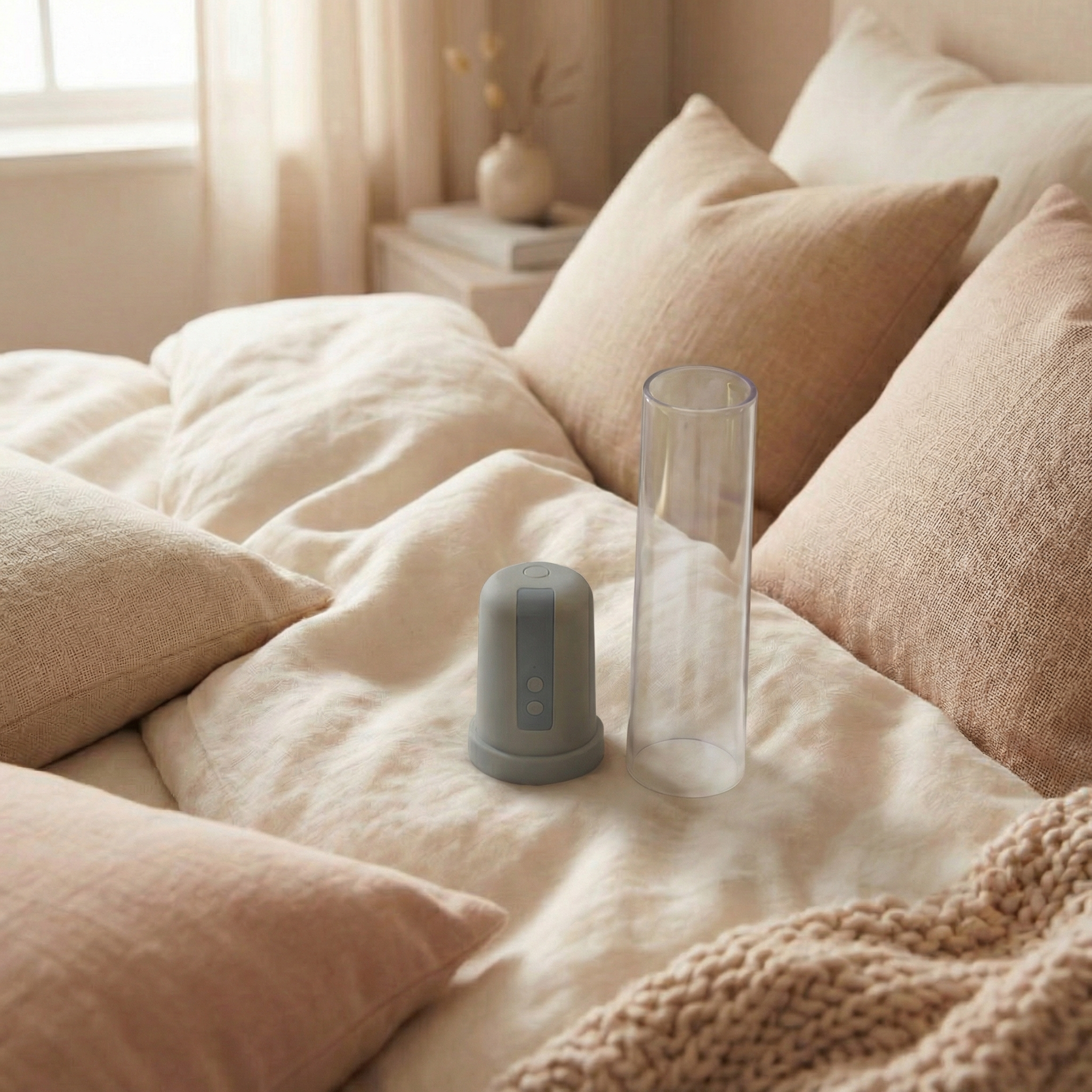
Rechargeable and push-button: for anyone who finds pumping by hand difficult, for example because of arthritis. Medical model.
Works with pulsing waves instead of vibrations, which means it also works when the penis stays soft or only half firm. Our recommendation for every man who thinks that part of life is over.
The Pulse for two: it sits between you, and she feels the vibrations too. Making love without needing an erection.
The Pulse with a remote control and more power, for anyone who knows the Essential and wants more.
A massage oil with the scent of strawberry and sparkling wine: pleasantly warm on the skin and slowly absorbed, just right for a long massage.
Silicone-based with a warm citrus scent: glides for a very long time and can then double as a lubricant, safe with latex condoms.
Five small massage oils in a case: a different scent every evening. A lovely gift for the two of you.
The board game for two, with tasks that range from innocent to daring. A whole evening in a box.
The big brother of the Sync, with a remote control that responds to how hard you squeeze. Luxurious, and well worth it.
A small, powerful toy for the clitoris that fits neatly between two bodies. Our bestseller among the small toys.
A strap with two handles that you place around your partner: something to hold on to when your back hurts, for a few tens of euros.
The best-known wedge cushion: support under the hips, knees or stomach, and a surprising number of positions suddenly become easy.
A Jaz with a rocking side: the movement comes from the cushion, not from your knees.
A compact air pulse vibrator with six settings: start gently, and for most women setting two is already enough. Small and quiet.
Air pulse plus vibration in a stylish toy, from our own brand House of Delight. The affordable choice that holds its own.
The air pulse stimulator for men: stimulates the glans without needing an erect penis. A completely different sensation from an ordinary masturbator.
Curious what else you would like to discover together? Take our fantasy test
All tests and buying guides at a glance
Not sure which vibrator suits you? Take our vibrator test
everything for an erection that won't cooperate
A good choice from the same group. On the product page you can read who it suits and how to use it.
One more choice, and you will see our recommendation.
A slim, soft mini vibrator that is also pleasant when making love feels sensitive; for the clitoris or very gently inside.
A simple pump with a pull lever to get started; less precise than the Vacurex, but a good deal cheaper.
Fifty-two cards, each with a position or a task: draw one and your evening is planned. From our own brand House of Delight; you can always skip a card.
Questions and tasks to get to know each other again after many years. Play it at the table with a glass of wine; the conversation flows by itself.
The couples' vibrator that stays in place while you make love and that you both feel; also lovely when his erection is no longer quite as firm.
A compact wedge cushion that lifts the pelvis or back just enough; the small lift that makes the difference between pain and pleasure.
A large sloping cushion that supports the whole back; for anyone who can no longer lie flat.
A cushion that folds open into a support for back and knees; made for anyone who can no longer manage kneeling and bending.
Not sure which lubricant suits you? Take our lubricant test
Which toy suits him? Take our men's test
Readers' experiences
Ans, 65
I was always prudish: sex only in the dark, under the covers. After my husband died, I thought that chapter was closed. Then, at 63, on a walking holiday, I fell head over heels in love, and a desire was unleashed that I had never felt before. Now the light goes on, because I want to see everything.
Truus, 68
Six years ago I had a stroke and was left paralysed down one side. Everything hurt and I no longer felt like a woman. It took me two years to ask my rehabilitation doctor for a sexologist; that was when it turned out my husband missed sex terribly but hadn't dared to say so. We rebuilt it step by step, with a cushion that supports my position and a vibrator with a long handle. It is slower and more vulnerable than it used to be, but also more intimate, and for a while I am not a patient.
Ria, 66
My husband has had erection problems for years. A pill used to help, but because of his heart he is no longer allowed to take it. I don't mind that we no longer have real sex, as he calls it; there are plenty of other ways. What does hurt is that he feels less of a man and keeps me at a distance because of it; he even goes to bed later than I do. A marriage without sex is no disaster. A marriage without cuddling is.
Gerrit, 78
As a boy of seventeen I learned that going to bed with a woman had to produce a result, and I carried that idea with me all my life. Now I can no longer get it up, and I realised it was precisely that thought that was holding me back. My wife and I started exploring other possibilities together, and it is now even better than I could have imagined. A kiss or a caress has taken on a deeper meaning.
Els, 63, and Hans, 62
Both widowed after marriages of more than thirty years. Before our first night I was terribly nervous: would it be awkward, would he need a pill, would I be dry, and what would he think of my body? It turned out to be wonderful. Hans had also wondered whether he should take something; starting slowly was enough. We have deliberately chosen to live apart and see each other at weekends. It feels as if we have been given a fresh start, with the desire of our younger years and the wisdom of today.
Wim, 74
I use a cock ring and, alongside that, a prescription erection pill, never everything at once, always one thing at a time. That way my wife and I manage about once a week. It is not as wild as it used to be, but after 52 years of marriage it is still going pretty well.
Joke, 62
I have been single for a very long time and was fine with that; for my pleasure I had my hands. During the menopause my desire disappeared and I did it less and less. A friend called an air pulse stimulator a miracle device. At first I thought it was a strange thing, but within a few minutes it took me to great heights again. I can see it in my eyes in the mirror: the energy is back.
What these stories have in common: it was not age that stood in the way, but shame, silence or a problem that could be solved. If you talk about it, with your partner or with your GP, you almost always find a way forward.
Starting again with a new partner
After a divorce or the death of your partner, someone new sometimes comes into your life after all. Lovely, and also a little daunting: a new body beside you, and your own body, which is different from thirty years ago. We wrote about dating itself in dating and making love again after a divorce or loss; here we focus on that first time in bed together.
Making love again after years alone: where do you start?
With yourself, and without rushing. If you haven't made love for years, you haven't forgotten how, but being touched may take some getting used to. First discover on your own what you enjoy now, with your hand or a small toy. Gynaecologist and sexologist Elke Franzki recommends: caress yourself in the shower the way someone who loves you would.
For many people desire simply returns, even after years. In a study of a hundred single people aged 60 to 83, sex was a normal part of life for many of them; their changed bodies were no reason to give up on it. Els (63) was terribly nervous before her first night with Hans: would she be dry, what would he think of her body? It turned out to be wonderful, she tells us above. Still looking? Read our comparison of dating sites for people over 40 and 50.
Having sex for the first time with a new partner later in life: how do you approach it?
Slowly, and by talking. Almost everyone is nervous, and so is the other person. Just say so; it takes away half the tension. A few lines that work, as long as you say them in your own words:
"I find this exciting, it's been a long time."
"Can I just hold you for a while first?"
"Tell me if something doesn't feel good, and I'll do the same."
"Not everything works automatically for me any more, so don't be alarmed."
An erection that doesn't come the first time is more often caused by nerves than by age; take the pressure off by agreeing that nothing has to happen that evening. For her: bring lubricant and use it generously, even if you never needed it before. And think of a condom: even after the menopause you can catch an STI; the condom is now not about pregnancy but about your health, and that is exactly why it is so often forgotten. An STI test through your GP or a sexual health clinic is a normal, sensible start to a new relationship; request it together, so it doesn't feel like an accusation.
Huub (68) met someone again eleven years after his divorce, at the bridge table. When she said he was welcome to stay the night some time, panic struck: would everything still work?
Our answer: an erection comes with relaxation, not on command. Say beforehand that you find it nerve-racking, agree that nothing has to happen and have a water-based lubricant ready. Read our full answer to Huub.
What does a long break do to your body?
In women, after the menopause the skin of the vagina becomes thinner and less supple, and the vagina becomes moist more slowly. After years without, the first time may therefore feel tight and sensitive. Take your time, use plenty of water-based lubricant and only move on to penetration when it feels truly pleasant. If it hurts, stop: there is plenty you can do without penetration.
If you are also dry during the day, a moisturiser helps. If it stays painful or you bleed after making love, see your GP: they will look for the cause and can prescribe a hormone cream or pessary. More in what changes for women.
In men, the penis needs more time and more direct touch than it used to, and nerves don't help. A cock ring helps maintain an erection once it is there; wear it for half an hour at most. More in what changes for men.
When should you both take an STI test?
Before you continue without a condom, both of you should get tested. Until then, use condoms in the right size; put it on together, which instantly makes it more fun. Prefer not to go to your GP? The Dutch sexual health organisation Soa Aids Nederland lists which home tests are reliable. If you use a vaginal cream or pessary, ask your pharmacist whether it is compatible with a condom: oil-based products damage latex.
How do you say what you enjoy?
Briefly and simply while making love: "Slower, that's lovely." "Here, like this." "What do you like?" Your previous partner often knew exactly what you enjoyed; a new one still has to learn. Sexologist Christa Gubler recommends: tell each other the story of your bodies. Where does that scar come from? And in her words, a little tummy can easily become a ski slope.
And feel free to laugh when a button won't come undone or a leg goes to sleep; laughing together takes away a lot of tension.
Aids without embarrassment
Aids are simply part of it, even the first time. Put the lubricant on the bedside table, and perhaps a toy for two or a ring for him. Our product guide helps you choose what suits you.
And if the first time is disappointing? Then you have shared an experience, and next time you start a good deal further along. That is how it goes at any age.
Keeping it enjoyable
A set evening each week when the television stays off. A massage with no expectation of anything more. A night in the guest room, or in the hotel you used to visit years ago. Showering together before bed. It does not have to be anything grand: most couples who keep things fun simply do something different from the usual every now and then.
And laugh at what does not go to plan. A creaking knee, an erection that takes a little break, a lubricant pump that squirts too hard: if you can laugh about it, you make love better.
Finally: desire has no expiry date
Sex later in life does not have to become quieter, smaller or more limited. Quite the opposite. For many people over 60, intimacy actually becomes richer, freer and more relaxed than ever. You know yourself better, you know what you enjoy and you are more willing to say what you desire. And those are exactly the ingredients for a deep, sensual and fulfilling sex life.
Of course the body changes. Of course arousal sometimes takes more time, and sometimes a little help. But nowhere is it written that desire stops as soon as the calendar shows a certain number. Desire lives on for as long as you give it attention. Connection grows when you keep talking, playing and feeling, and dare to stay curious.
So keep discovering, stay tender, stay curious.
Keep laughing, touching, fantasising and enjoying each other's company.
Your sex life has no expiry date. It simply holds an invitation: to keep on loving, at your own pace, in your own way, for as long as you wish.
Sexuality remains an important part of wellbeing and vitality, whatever your age. It is not about performance, but about connection, pleasure and discovering together what you enjoy now.
Frequently asked questions
Answers to your questionsClickTap on a question for the answer
Up to what age do people have sex?
There is no age at which it stops. Of people in the Netherlands aged 75 and over, 27 percent had sex in the past year, and among over-75s living with a partner the figure is 41 percent. People who live alone have far less sex at that age; having a partner matters at least as much as age does. See the figures for your age.
Up to what age can a woman have sex and reach orgasm?
For as long as she wants. The menopause changes the body (drier, slower to become aroused), but not the ability to enjoy sex or to orgasm; the clitoris simply keeps working. What helps: more time, lubricant, and touch that suits the body you have now. Pain is not part of getting older but something to resolve; read menopause and sex.
Up to what age can a man have sex?
There is no limit there either. After 60 an erection comes more slowly, is often less firm and needs more direct touch, but orgasm and pleasure remain possible well into old age. A cock ring, an erection pump or a masturbator that also works without an erection can make the difference between giving up and carrying on; also read dealing with erectile dysfunction.
How many older people are sexually active?
According to Statistics Netherlands (CBS, 2022), 70 percent of 55 to 65-year-olds had sex in the past twelve months, as did 53 percent of 65 to 75-year-olds and 27 percent of over-75s. Among men over 75 the figure is 37 percent, among women 18 percent, mainly because older women are more often on their own (source).
Do women of 80 still want sex?
Yes, some of them certainly do, although the CBS figures say nothing about desire, only about having sex: of women over 75, 18 percent had sex in the past year, and of over-75s with a partner at home, more than four in ten. Desire changes shape: it arises less spontaneously and more as a response to warmth and touch. A woman who still feels desire at eighty isn't odd; she's healthy.
How do you rekindle desire in a partner of 70?
With touch that comes without obligation, not with a pill or a surprise attack. A massage, a shower together, an evening without the television, and saying out loud what you miss, without reproach. For a man, the obstacle is often an erection that no longer comes by itself; for a woman, dryness or pain. Address that first; above you can read how.
Is sex healthy at an older age?
Yes. There is no evidence that sex after 60 is harmful for healthy people, and those who make love regularly feel healthier on average, sleep better and feel less lonely. Sex is a sign of vitality rather than a risk.
Is sex safe after heart problems or with diabetes?
Usually, yes. Making love takes about as much effort as climbing stairs; if you can do that without symptoms, you can usually make love too. After a heart attack, your cardiologist or cardiac rehabilitation team will tell you when it's possible again; with diabetes, dryness and erections in particular need attention. If you take medication for your heart, blood pressure or diabetes and notice new symptoms, talk to your GP; also read your sex life after a heart attack.
What can you do about vaginal dryness?
A good water-based lubricant such as Hydra+ during sex, a longer warm-up and gentle touch help most. If you also feel dry or a burning sensation during the day, a moisturiser such as JO Renew keeps the mucous membrane supple. If it keeps hurting, your GP can prescribe a hormone cream; do get in touch with them.
How does sex change as you get older?
Mainly in pace and form, not in whether it's still possible. Arousal comes more slowly, penetration becomes less central and foreplay becomes more important. Many people over 60 actually find their sex life more intimate, calmer and more sensual than before, with less haste and more attention.
Having sex for the first time with a new partner later in life: what should you keep in mind?
Say that you find it exciting, agree that nothing has to happen, bring lubricant and use a condom, because you can still catch an STI after the menopause. An STI test through your GP or a local sexual health clinic is a perfectly normal start to a new relationship. Read our tips and dating and making love again.
How do I start having sex again after years without?
Gently, and with yourself first: through touch, and perhaps a small toy, you rediscover what your body enjoys now. After the menopause the vagina needs more time and lubricant helps, and erections also need more time and direct touch. With a new partner: say that it's been a long time, agree that nothing has to happen, use condoms and both take an STI test before you stop using them. If sex hurts, see your GP. Read how to start again.
Which positions work well when your knees, hips or back hurt?
Positions in which nobody has to carry weight: spooning, side by side facing each other, sitting on the edge of the bed, on your back with a wedge cushion under your hips (he stands beside the bed), or standing while leaning on the bed. All six with illustrations are shown above; a sex cushion makes every position easier.
When should you see your GP or a sex therapist about sexual problems?
When there's pain that doesn't go away with lubricant and time, an erection that doesn't come even in the morning, bleeding after sex, or desire that has disappeared completely for months and makes you unhappy. Your GP looks at medication and your health; a sex therapist helps when the issue is in your head or between the two of you. Talking about sex is everyday work for them; for you it's a step, and a good one.
Sources and methodology
Based on the sources below and on published personal accounts from people over 60. This blog is meant as inspiration and does not replace advice from a doctor or sexologist: if you have pain, bleeding, an erection that stays away in the morning too, or heart problems, see your doctor.
Statistics Netherlands (CBS). Increase in sexual activity among people over 75. Health Survey/Lifestyle Monitor, with RIVM, Rutgers and Soa Aids Nederland, 17 March 2023. view source
Rutgers. Key figures Lifestyle Monitor Sexual Health 2024. 2025. view source
De Graaf H et al., Rutgers. Sexual Health Monitor 2023. 2024. view source
Dutch College of General Practitioners (NHG). NHG guideline on menopause. 2022 revision. view source
NVOG, Federation of Medical Specialists. Guideline on menopause management, module on the treatment of urogenital atrophy. 2026. view source
Pellegrino F et al. Relationship between age, comorbidity, and the prevalence of erectile dysfunction. European Urology Focus, 2023. view source
Stentagg M, Skär L, Sanmartin Berglund J, Lindberg T. Cross-sectional study of sexual activity and satisfaction among older adults 60 years of age and older. Sexual Medicine, 2021. view source
Cameron J, Santos-Iglesias P. Sexual activity of older adults: a systematic review of the literature. International Journal of Sexual Health, 2024. view source
Beerepoot S, Luesken SWM, Huisman M, Deeg DJH (Amsterdam UMC, LASA). Enjoyment of sexuality and longevity in late midlife and older adults. Journal of Applied Gerontology, 2022. view source
Wang Y et al. The association of sexual frequency with cardiovascular diseases incidence and all-cause mortality. Scientific Reports, 2024. view source
Dutch Heart Foundation (Hartstichting). The effect of medication on sex and intimacy. 2025. view source
Dutch Diabetes Association (Diabetesvereniging Nederland). Sexual problems with diabetes. 2024. view source
ReumaNet. Intimacy and sexuality in rheumatic conditions. 2023. view source
Kerssies J, Bendien E (Leyden Academy on Vitality and Ageing). Desire at any age: time to listen appreciatively to older people about sexuality. Dutch Journal of Gerontology and Geriatrics (Tijdschrift voor Gerontologie en Geriatrie), 2026. view source
Vermeeren E. How sex changes as you get older, with physician and sexologist Elise van Alderen and Ymke Kelders (Rutgers). NU.nl, 2024. view source
Harris L, Melanson C (University of New Hampshire). “The Shop Is Not Closed”: Sex and Sexuality Among Older Adult Daters. Journal of Sex Research, 2026. view source
Soa Aids Nederland. When should you get an STI test? 2025. view source
Thuisarts. I want to start using condoms. Dutch College of General Practitioners (NHG), 2025. view source
Franzki E, gynaecologist and sexologist. “Sexualität hört nicht einfach auf, sie verändert sich”. Interview, WEB.DE, 2025 (archived copy). view source
Gubler C, psychologist and clinical sexologist. In: Partnersuche & Sexualität: Tipps für einen zweiten Frühling. SRF, 2026. view source
About the figures in Sex later in life: myths and reality: the first three figures come from Statistics Netherlands (CBS) (Health Survey/Lifestyle Monitor 2022, with RIVM, Rutgers and Soa Aids Nederland), the fourth from the Rutgers Sexual Health Monitor 2023.