Updated on

Natural lubricants: choosing the best of pure nature

The Violet Empress editorial team
Tuin vol aloëplanten met oranje bloeiaren, tussen terracotta potten en stenen

The short answer

For us, the best natural lubricant is Slowmass: an unscented oil made from seven plant oils which, unlike almost any other oil, can also be used with silicone toys. With a condom, choose a natural water-based lubricant, and then Pjur Organic Touch is our firm recommendation: 98 per cent natural and vegan.

These are our favourites, in order:

  • Number 1, for massage, foreplay and with toys: Slowmass; not with a condom.
  • The kitchen favourite, but in its purest form: the coconut oil from Eterea, one hundred per cent organic, for massage and foreplay.
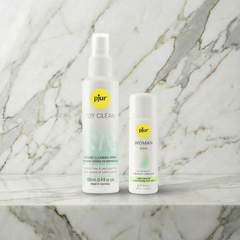
  • Water-based, also with a condom: Pjur Organic Touch, and the excellent, vegan Pjur Woman Aloe, which our test panel gave an 8 out of 10.
  • One hundred per cent natural, with a quality label: BIOglide; opinions on it are mixed, and we will honestly tell you why.
  • One of our great favourites for years: Intimate Earth, unfortunately made in America and therefore hard to get hold of.
  • For dryness or sensitive skin: as few irritants as possible, as with our lubricants with a short ingredients list.
  • Coconut or avocado oil from the kitchen: fine on the skin, never with a condom; our kitchen check tells you what works for each one.

Which natural lubricant suits you? Answer two questions in our guide and you will see our advice straight away.

Natural always sounds good, even on a tube of lubricant.

More and more people are choosing a natural lubricant. But what does that actually mean? Is a natural lubricant really better for your body? And for nature? And how do you know whether a product is truly natural?

We have been selling lubricant for a very long time and regularly receive questions about it: from women whose lubricant makes them burn, from women going through the menopause who are looking for something natural without that sour smell, and online, above all, whether coconut or avocado oil from the kitchen will do. You will find our answer to all of these questions here.

Choose below where you would like to start; the guide to help you choose is directly underneath.

Guide

Where would you like to start?

What are you looking for, and how much do you already know about it? Choose a box below and you will see straight away where to go, here on this page or in one of our other guides on lubricant.

Choose a box and your route will appear.

Selection guide

Which natural lubricant suits you?

Answer two questions and you will immediately see our recommendation plus two alternatives, with today's price and, where our test panel tried the lubricant themselves, the score it received. After that you can refine further. Would you prefer detailed, personal advice on every type of lubricant? Then take our lubricant test.

1. What do you mainly use it for?Most depends on this: not everything is suitable with a condom or a toy.
Not sure; what do we recommend?

Do you use it for all sorts of things, or are you unsure? Then choose a natural water-based lubricant. It works with and without a condom, with any toy, and it rinses away easily with water. Keep an oil for massage.

Choose above what you mainly use it for. Then we ask what natural means to you, and you immediately see our advice.

Still unsure? Take the full lubricant test: a few short questions and personal advice. All the natural lubricants side by side can be found further down in the comparison.

Prices come directly from our shop.

What is a natural lubricant?

A natural lubricant is a lubricant made largely or entirely from ingredients of natural origin, without synthetic additives such as silicone, parabens or artificial fragrances. Think of water, plant-derived glycerine, aloe vera or a vegetable oil.

The catch: natural is not a protected term. A manufacturer can put it on the tube as soon as a few natural ingredients are included, even if the rest comes from a laboratory. If you want to be sure, turn the tube over and look at the ingredient list and for a quality mark. You will find how to read them below.

Can any manufacturer call a lubricant natural?

Yes. In Europe there is no legal standard for natural or organic cosmetics; the European Commission says so itself. A claim must not mislead the buyer, but only a quality mark is checked by an independent party. So look at the list on the back, not at the green label with leaves on it.

Some lubricants are not cosmetics but a medical device with a CE marking, such as Pjur Med Natural Glide; stricter safety rules apply to these, but even then the word natural says nothing about the product as a whole.

Natural is not a protected term. A manufacturer has to earn a quality mark; the word natural it can simply print on the label.

Our rule of thumb for every label

What is in natural lubricants?

A natural water-based lubricant follows a simple recipe: water, something that retains moisture, something that thickens it and something that keeps it fresh. On the label you will see this reflected as follows:

  • Water (aqua). The base: light, not sticky, and easy to rinse away.
  • Plant-derived glycerine. Makes it soft and keeps it moist; a little is fine, a lot makes it concentrated (more on that further down).
  • A natural thickener, such as xanthan, guar gum or carrageenan from seaweed: this gives it a silky texture rather than a watery one.
  • Aloe vera. Soothes and feels fresh, as in Pjur Woman Aloe.
  • A mild preservative, such as lactic acid or potassium sorbate: without one, bacteria and mould quickly grow in a water-based product.
  • Vegetable oil, such as avocado, almond or coconut oil, only in an oil such as Slowmass: nourishes the skin and stays smooth for a long time, but cannot be used with a condom.

If you want (almost) everything to be of natural origin, the water-based choice is Pjur Organic Touch, and in oil form Slowmass or the coconut oil from Eterea. All the natural and organic lubricants we sell are gathered together in our natural lubricants.

What is left out?

In a natural lubricant, certain ingredients are deliberately left out. Here is what you would rather not find in it, and why:

  • No fragrance and no colourings. They irritate sensitive skin, and they have no business on a mucous membrane.
  • No parabens. Preservatives you do not need in a lubricant; you can read below which lubricants are free of them.
  • No silicones. Ultra-slippery, but they break down poorly in the environment and damage a silicone toy. They are not bad for the skin: with severe dryness they often give the most relief.
  • Not too much glycerine or propylene glycol. In themselves they are not a problem; it is the amount that matters, and that is not printed on the tube. In a high dose they draw moisture out of the mucous membrane, and then it burns. Even our mildest lubricants, such as Hydra+ and Pjur Med Sensitive, contain some propylene glycol; if a lubricant burns for you, it is worth trying one with less of these two.
  • No warming, cooling or tingling effect. Menthol, cinnamon and pepper create a sensation, and with sensitive skin that quickly becomes too much.
  • No spermicide or disinfectant, such as nonoxynol-9 or chlorhexidine. These irritate the mucous membrane; GPs who have summarised this for their colleagues name exactly these substances (source).

You can read more about each ingredient, including the borderline cases, in safe and unsafe ingredients in a lubricant.

Lubricant without parabens: which ones are they?

Almost every lubricant is paraben-free these days: all the natural lubricants in this guide, and our entire selection with a short ingredient list as well. When we went through the labels in our shop, we found them in only a single product, such as a lotion for masturbators; and in a Danish inspection of 43 lubricants in early 2026, only one still contained a paraben.

Parabens are preservatives. In the permitted amounts they have been found safe for cosmetics in Europe, but some people react to them, and you do not need them in a lubricant: lactic acid, potassium sorbate or levulinic acid do the same job. If you want to be sure, look on the label for anything ending in -paraben, such as methylparaben or propylparaben. If it is not listed, it is not in there.

Are natural lubricants better for the skin?

Not automatically. Whether a lubricant is truly kind to the skin depends on its quality, not on the word on the packaging.

Two things make the difference, and they are rarely printed in large letters on the tube. The first is acidity: a healthy vagina is slightly acidic (pH 3.8 to 4.5), and a lubricant for vaginal use should ideally be close to that, around 4 to 4.5. The second is how concentrated it is. A lubricant with a great deal of glycerine or propylene glycol is, as it were, saltier than your own moisture, and then draws water out of the mucous membrane: that feels dry or burning. The World Health Organization therefore sets a limit on how concentrated a lubricant may be (source); glycerine and propylene glycol together then stay below roughly 8 percent. This concern comes mainly from the laboratory, and the results in women themselves are mixed, but if a lubricant burns or dries you out, a product with less glycerine is worth trying.

What a good natural lubricant can do for you:

  • Fewer additives: the less there is in it, the less there is to react to.
  • Pleasant for sensitive skin, as long as the acidity is right.
  • For those who take the environment into account: without silicones a lubricant breaks down more easily; you can only tell whether it is truly environmentally friendly from a certification label.

What we see ourselves is mainly that women who get a burning feeling from an ordinary lubricant benefit from a product with as little in it as possible, natural or not. That is why our comparison also includes the mildest lubricants that are not natural.

Are there any downsides?

Yes, a few. Natural feels soft and pleasant, but it sometimes asks a little more of you:

  • They dry out faster. You top up a little more often; a few drops of water will often make it slippery again.
  • Sometimes a sticky film, from plant-based ingredients that dry out.
  • The right acidity isn't a given. Check whether the pH is stated on the packaging or the product page.
  • Once opened, sometimes a shorter shelf life. With a gentle preservative, it keeps for less time after opening; Pjur Organic Touch, for example, keeps for six months. The open jar symbol on the packaging tells you how long.
  • Oil and condoms don't mix. Oil weakens latex, so with a condom always choose a water-based lubricant.
  • Natural is not the same as non-allergenic. People can react to aloe vera, cinnamon or nut oil too. Try a new lubricant on the inside of your wrist first.

How do you recognise a truly natural lubricant?

The label on a lubricant can tell you a great deal about what is in it. Turn the tube over and run through these points:

  1. Read the ingredient list, not the front. The shorter and more recognisable the list, the better. Whatever is listed first makes up the largest share.
  2. Look for the familiar names. Aqua is water, glycerin is glycerine, xanthan gum is xanthan, aloe barbadensis is aloe vera. You can't tell from the name whether the glycerine comes from plants; a vegan certification does tell you that.
  3. Avoid perfume (parfum or fragrance), parabens (anything ending in -paraben) and menthol or cinnamon if you are sensitive; if a lubricant stings or burns, choose one with less glycerine or propylene glycol.
  4. Look for a certification mark. COSMOS, Ecocert, NATRUE, BDIH, and for vegan products the Vegan Society or the V-Label: these are checked by an independent body, whereas the word natural is not.
  5. Check the acidity and the open jar symbol. A pH of around 4 to 4.5 for vaginal use, and the open jar symbol showing, for example, 6M: that is how many months it keeps after opening.

Our favourites, in order

Of course, choosing is personal. This is our ranking, with today's price and two alternatives; where our test panel tried the lubricant themselves, you will find their score. And to be honest: the American Intimate Earth has been one of our great favourites for years, but it is hard to get hold of, which is why it appears as an alternative rather than at the top.

Our number 1: Slowmass

Seven plant oils, also suitable for silicone toys

Slowmass is the big name in this field: seven plant oils, including avocado and almond oil, unscented and certified organic. What makes it special: most oils damage silicone toys, but this one does not; the manufacturer says so and we tested it ourselves. For massage and for sex without a condom; if you use a condom, choose a water-based lubricant.

The kitchen favourite, but pure: coconut oil from Eterea

One hundred percent organic, for massage and foreplay

One hundred percent organic coconut oil from the Italian brand Eterea, with no fragrance, colouring or preservative: soft, rich and slightly thicker, lovely for a massage or yoni massage. Below 24 degrees it turns solid; simply stand the bottle in warm water for a moment. Not for use with a condom or with silicone toys.

Water-based and as pure as possible: Pjur Organic Touch

98 percent natural and vegan, also for dryness

If you want a water-based lubricant made almost entirely from natural ingredients, this is our strong recommendation: water, plant glycerine, xanthan and a few mild ingredients that keep it fresh, 98 percent of natural origin and vegan. Made to soothe a dry vagina, it is compatible with latex and polyisoprene condoms and with toys; once opened, it keeps for six months.

Very good, and an 8 from our test panel: Pjur Woman Aloe

Vegan, with aloe vera and the natural acidity of the vagina

Certified by the Vegan Society and with the same acidity as a healthy vagina (pH 4 to 4.5). Our test panel gave it an 8: “Light fresh scent, not sticky, slightly thicker, nice with toys, long-lasting.” It is not entirely natural (it contains a standard preservative), but it is gentle and reliable.

One hundred percent natural, with one caveat: BIOglide

With the certification for natural cosmetics

If it really has to be completely natural, there is BIOglide: certified as natural cosmetics by the BDIH, free from synthetic preservatives, with plant glycerine as its base. We read the label carefully and it checks out. Opinions vary: some find it soft and slightly sweet, others a little sticky. Compatible with condoms and with silicone toys.

Gentle rather than natural: Hydra+

Our own lubricant, an 8 in our test

Not everything that is gentle is natural. Our own Hydra+ is not natural, but it is gentle: free from perfume, colouring and flavouring, pH 4 to 4.5, made in the Netherlands. Our test panel gave it an 8: “Unscented, neither thin nor thick, not sticky, lasts a very long time, nice bottle.”

Our recommendations under the microscope: what is in them, and what is not?

The label of each recommendation in plain language, taken from the ingredient list on the product page. An oil contains no water and needs no preservative; a water-based lubricant does, and preferably a mild one. For comparison, our own Hydra+: not natural, but free from perfume and colouring.

Slowmass Natural Oil

Plant oil, 125 ml

Containsavocado oilsesame oilsweet almond oilbaobab oilhemp oilprickly pear oilcamellia oil
Does not containwaterpreservativeperfumesiliconesulphatesglycerine

BioInspecta, BioVidaSana, vegan

Pure and Natural coconut oil

Plant oil, 150 ml

Containsorganic coconut oilvitamin E
Does not containfragrancecolouringparabenspreservativeglycerinesilicone

Organic farming, vegan

Pjur Organic Touch

Water-based, 100 ml, 98 percent natural

Containswaterglycerinexanthanlevulinic acid and sodium levulinatesodium anisatesodium hydroxidetremella mushroom extract
Does not containperfumeparabenscolouringsiliconeoil

Vegan; keeps for six months after opening

Pjur Woman Aloe

Water-based, 100 or 30 ml, pH 4 to 4.5

Containswaterglycerinexanthanbenzyl alcoholsodium benzoatecitric acidpotassium sorbatealoe vera
Does not containparabensparaffinsynthetic perfumecolouringsiliconeoil

Vegan Society

BIOglide

Water-based with plant glycerine, 150 ml

Containsglycerinewatersodium lactatealcoholxanthanlevulinic acidlactic acidsodium levulinate
Does not containsynthetic preservativefragrancecolouringparabensoilsilicone

Natural cosmetics (BDIH), vegan

Hydra+

Water-based, 150 ml with pump, pH 4 to 4.5; not natural

Containswaterpropylene glycolglycerinehydroxyethylcelluloselactic acidPEG-150PEG-8ethylhexylglycerinphenoxyethanol
Does not containperfumecolouringflavouringparabensoilsilicone

Dermatologically tested, made in the Netherlands

Natural vs organic lubricant

Natural and organic are often used interchangeably, but they do not mean the same thing. Organic is about how the ingredients are grown: without pesticides or artificial fertilisers. In cosmetics this is not a legal term either; only a certification label checks it, and COSMOS Organic then requires 95 percent of the plant-based ingredients to be organic, and 10 percent of the whole product in the case of a water-based formula. Natural simply means that the ingredients come from nature, whether or not they have been processed or supplemented.

FeatureNatural lubricantOrganic lubricant
IngredientsOf natural origin, but not necessarily organically grownOrganically grown without pesticides or artificial fertilisers
Synthetic additives?May be presentA small percentage is allowed, provided the certification label approves it
Who checks it?Nobody: there is no legal definitionA certification label such as COSMOS Organic or Ecocert; not regulated by law either
More sustainable?Sometimes, but not alwaysThe farming is; for everything else, look at the certification label
The right pH?Not automatically, you need to checkNot automatically, you need to check

A water-based lubricant with an organic certification for the whole product is rare, because water cannot be organic. That is why you will see a natural cosmetics label (BIOglide) or organic extracts in a standard formula (Intimate Earth). With oil it is easier: Slowmass is certified organic and the coconut oil from Eterea is one hundred percent organic.

Vegan is something else again: nothing from animals and not tested on animals. The Vegan Society label, for example, appears on Pjur Woman Aloe. So: natural does not always mean pure, and organic does not automatically mean entirely natural; with a certification label, at least someone else has checked it.

Our natural lubricants side by side

What the label says, gathered in one table, in the order of our recommendations: the base, how natural it is and which certification label, whether it can be used with a condom and a silicone toy, whether it contains glycerine, and our test panel's score if we tested it ourselves. At the bottom, for comparison, you will find the mildest lubricants that are not natural. Click on a column to sort.

Sort by:
LubricantBaseNaturalCondomSilicone toyGlycerineOur scorePrice
Slowmass Natural OilPlant oilBioInspecta, BioVidaSana, vegan; (almost) entirely naturalNoYesNonot tested
Pure and Natural coconut oilPlant oilOrganic farming, vegan; (almost) entirely naturalNoNoNonot tested
Pjur Organic TouchWater98 percent natural, vegan; (almost) entirely naturalYesYesYesnot tested
Pjur Woman AloeWaterVegan Society; largely naturalYesYesYes8
BIOglideWaterNatural cosmetics (BDIH), vegan; (almost) entirely naturalYesYesYesnot tested
Pjur Med Natural GlideWaterLargely naturalYesYesYesnot tested
Intimate Earth DefenseWaterCertified organic extracts, vegan; largely naturalYesYesYes6
Intimate Earth StrawberryWaterUSDA Organic, vegan; largely naturalYesYesNo8.5
Hydra+For comparisonWaterNot naturalYesYesYes8
Pjur Med Repair GlideFor comparisonWaterMild, not naturalYesYesYes8
Pjur Med SensitiveFor comparisonWaterMild, not naturalYesYesNo7
Pjur Woman NudeFor comparisonWaterMild, not naturalYesYesNo7
Intimate Earth Hydra NaturalAlso testedWaterVegan, organicYesYesNo8+

The prices come straight from our shop; at the bottom you will find a lubricant that we also tested but no longer sell.

Go to all our natural and organic lubricants, or to lubricants with a short ingredient list.

How we tested

Our test panel tried the lubricants at home and paid attention to scent, thickness, stickiness, how long they last and how much you need; their findings are quoted word for word in our lubricant test. Where it says "not tested", we have not tried that lubricant ourselves. We take the pH, quality mark and condom safety from the label and the manufacturer: we do not have a laboratory of our own.

Can you use avocado oil as a lubricant?

For a massage, yes; with a condom, no; and inside the vagina, preferably not. Avocado oil is a rich, gentle oil that the skin tolerates well, but it is still an oil: it does not dissolve in water, it lingers for a long time and it weakens latex, so a condom can tear (source). The same applies to coconut oil, olive oil and almond oil. For anal play without a condom, a plant oil is fine.

There has been no research into avocado oil as a lubricant, and doctors do not agree about oil in the vagina either: some women never have any trouble with it, others do. We err on the side of caution: oil for massage, and a water-based lubricant for inside the vagina.

What else do you have at home? Click it below.

Kitchen check

What do you have at home? Click it and you will see straight away whether it works: for massage, in the vagina, anally, with a condom and with a toy.

Choose something from your kitchen or bathroom above.

Would you like the softness of oil, but with a silicone toy? Slowmass is one of the few oils that does not damage silicone; we tested that ourselves. And how best to use lubricant, how much and where, you can read in how to use lubricant.

Your questions, our answers

These are questions our customers ask us, and this is how we answer them.

My lubricant burns; would a natural lubricant help?

Often it will, but not because it is natural: burning usually comes from fragrance, a warming or cooling effect, or a product that is too concentrated. Choose a lubricant without fragrance and with as few ingredients as possible, such as Pjur Organic Touch, or one without glycerine, such as Pjur Med Sensitive (not natural, but gentle). If the burning persists or keeps coming back, have it checked by your GP; you can read more in pain during sex caused by a vaginal infection.

I am looking for a natural lubricant for dryness during the menopause, without a sour smell

Some natural products smell of their ingredients; our test panel actually found that Pjur Woman Aloe smelled fresh, and Pjur Organic Touch is designed to soothe a dry vagina. If you are also dry during the day, or it itches or stings, a moisturiser used a few times a week, separately from sex, will help. Everything about dryness during the menopause can be found in the best lubricant for the menopause.

Slight fresh scent, not sticky, a little thicker, lovely with toys, lasts a long time.

Our test panel on Pjur Woman Aloe, score 8

How long does lubricant keep, unopened and after opening?

Unopened and stored somewhere cool, usually a few years; the date is on the packaging. After opening, look for the open jar symbol with a number and an M: that is how many months it keeps. Natural lubricants often have a shorter shelf life; Pjur Organic Touch keeps for six months. If it smells, looks or feels different, throw it away.

A lubricant that also works for massage and does not irritate the vagina

Then you are caught between two wishes: oil is wonderful for massage but less pleasant in the vagina, and water-based lubricant dries out quickly during a massage. What works for many couples: Slowmass for the massage with a water-based lubricant alongside it. If you want one product for both, Hydra+ is an option: not natural, but soft and a little thicker. Our tested massage oils can be found in massage oils for an erotic massage.

Do you need lubricant in the bath too?

Often you do, in fact: water washes away your own natural moisture, and water-based lubricant dissolves quickly in the bath. Silicone-based lubricant stays slippery the longest in water, but it is not natural and cannot be used with a silicone toy; oil makes the floor as slippery as ice. Read more in sex in the water.

The lubricant quiz

Which lubricant suits you?

No more than six short questions. Then you will see which lubricant we recommend for you, with two alternatives and the reason why.

  • We never send your sensitive answers anywhere
  • Done in about a minute
  • You can always go back a step

Readers' experiences

How others got on with a natural lubricant or something from the kitchen, in brief. The names have been changed, the stories have not.

Hanneke is past the menopause and takes anastrozole.

Since her breast cancer, her medication suppresses her oestrogen, so she is often dry and needs lubricant. Her cheap supermarket product feels so artificially slippery, even with just a tiny amount, that she is looking for something more natural. And once lovemaking gets going, she becomes wet on her own anyway, so then it is simply too much.

Robin was not impressed by an ordinary shop-bought lubricant.

It was the stuff from the supermarket, and it simply did not do the job. Then a natural, organic lubricant came into the house, and that was a different story: much nicer.

Sam goes for a hybrid lubricant.

That is a blend of water and silicone. Water-based on its own dried out too quickly, silicone on its own did too, and oil was too messy; the blend turned out to be the happy medium.

Jo has been using coconut oil for a few years now.

And there is no talking Jo out of it: a few water-based lubricants from the shop did not even come close.

Dani uses almond oil.

Dani started with coconut oil, but over time the smell became too much. Now it is almond oil, and Dani and their partner are both happy with it.

Tineke struggled with sensitivity and pain.

She chose a vaginal oestrogen product, alongside a natural water-based lubricant. In her experience it feels much more natural and comes closer to normal vaginal moisture. It worked well for her.

Sandra (49) was suddenly thrown into the menopause by chemotherapy.

Because of the hormone therapy following metastatic breast cancer, her oestrogen has to stay at zero, so she cannot try the medication that is often recommended for dryness. She compares the pain to a knife being twisted. Only a silicone-based lubricant gives her some relief, but a spontaneous romantic evening is no longer on the cards.

Monique has lichen sclerosus.

She and her boyfriend use coconut oil. He is perfectly happy with it, and because it is completely natural, there are no chemicals in it that could make her skin flare up. If you have lichen sclerosus, you will find more in lubricant and dilators for lichen sclerosus.

What our test panel said

On the Pjur Woman Aloe (score 8): "Slight fresh scent, not sticky, a little thicker, nice with toys, lasts a long time."

On our own Hydra+ (score 8): "Odourless, neither thin nor thick, not sticky, lasts a very long time, nice bottle."

On the Pjur Med Repair Glide (score 8): "Odourless, neither thin nor thick, not sticky, forms a protective layer, glides for a long time."

On the Pjur Woman Nude (score 7): "Odourless, thin, not sticky, lasts long and works well, you do need a bit more, few ingredients."

On the Intimate Earth Defense (score 6): "Odd smell, thin, not sticky, lasts a long time."

All seventeen lubricants from our test, with their scores and findings, can be found in the best lubricant.

Lubricant in figures

How many women actually need lubricant, and how many use it? The figures, from the Netherlands and from Europe where available.

How many women need it, and how many use it?Figures from the Netherlands and Europe on dryness during the menopause, after giving birth and with medication, and on who uses lubricant.Show the figures
  • 11%of Dutch women often or always did not become wet enough during sex in the past year; for 6 percent it is a problem that bothers them a great deal.
  • 3 in 10women develop symptoms during or after the menopause because the mucous membrane becomes thinner and drier, according to the guideline of the Dutch general practitioners.
  • 7 in 10women aged 40 to 70 visiting a gynaecologist had vaginal dryness in a Greek study; but only 3 in 10 had ever discussed it with a doctor.
  • Well over halfof women who are breastfeeding have vaginal dryness; six months after giving birth, 4 in 10 still have pain during sex.
  • 4 in 10women taking an aromatase inhibitor after breast cancer have vaginal dryness; 3 in 10 have pain during sex.
  • 2 in 3American women have used lubricant at some point, 1 in 5 in the past month (2012 survey). Among European women aged 60 to 75: from 3 percent in Belgium to 31 percent in Norway (2016 survey).

The Dutch figure comes from the Rutgers Sexual Health Monitor 2023 (more than 15,000 people aged 18 to 80), which also shows that women taking medication for a chronic illness more often have a sexual problem (17 versus 13 percent). The menopause figure is from the Dutch GP guideline on the menopause (NHG-Standaard De overgang, 2022), the Greek figures from the LADY study (2024), the figures on giving birth from a review of 65 studies (2025), and the aromatase inhibitor figure from an American study of 974 women (2023). How many women use lubricant has never been measured in the Netherlands; the two usage figures are the most recent large surveys available (published in 2014 and 2020).

In conclusion

A natural lubricant is a lovely choice if it suits you, and you will notice soon enough whether it does: soft, smooth, and you simply stop thinking about it. If you are torn between two, buy the smallest bottle and just give it a try. If it stings, it is usually not down to you but to what is in it, and you now know all about that. Enjoy, and do feel free to tell us how you got on; we learn from it, and so does the next reader.

Still unsure, or would you like personal advice in just a few clicks?

Our product finder above is the quick route: two questions, natural lubricants only. The lubricant test is the more thorough option: a few more questions, covering every type of lubricant, with advice tailored to you.

Take the full lubricant test

Frequently asked questions about natural lubricant

Answers to your questions ClickTap on a question for the answer
What is the best natural lubricant?

For us it is Slowmass: an unscented oil made from seven plant oils, certified organic, which, unlike almost any other oil, can also be used with silicone toys. With a condom, choose a natural water-based lubricant: Pjur Organic Touch (98 percent natural and vegan) or Pjur Woman Aloe (vegan, rated 8 out of 10 by our test panel). Which one suits you depends on what you use it for: our product finder helps you choose in two questions.

What is a natural lubricant?

A lubricant made largely or entirely from ingredients of natural origin, such as water, vegetable glycerine, aloe vera or a plant oil, without silicone, parabens or fragrance. Natural is not a protected term, so look at the ingredient list and for a certification label. You will find every type in our natural lubricants.

Can you use avocado oil as a lubricant?

For a massage, yes; with a latex condom, no; and in the vagina, preferably not. Avocado oil is gentle on the skin, but an oil does not dissolve in water, stays on for a long time and weakens latex. There has been no research into avocado oil as a lubricant. For anal use without a condom, it is fine. If you want an oil you can use with a silicone toy, choose Slowmass, which also contains avocado oil.

Can I use coconut oil as a lubricant?

Coconut oil works as a lubricant, but it is not suitable with latex condoms, because it damages the material. Doctors disagree about oil in the vagina; some women have problems with it, others do not. For that, we prefer a water-based lubricant. For a massage, coconut oil is lovely; Pure and Natural coconut oil is one hundred percent organic.

What is the difference between a natural and an organic lubricant?

Natural says something about origin: the ingredients come from nature, but synthetic substances may still be added and nobody checks this. Organic says something about how the ingredients were grown: without pesticides or artificial fertiliser. For cosmetics this is not regulated by law either, but a certification such as COSMOS Organic or Ecocert does check it. A water-based lubricant with an organic certification for the whole product is rare; with oils it is more common.

Which lubricant is vegan?

In our range, these include Pjur Woman Aloe (certified by the Vegan Society), BIOglide, Pjur Organic Touch, Slowmass and Eterea coconut oil. Vegan means: nothing from animals and not tested on animals. It says nothing about whether a product is natural or organic; those are separate certifications.

Is there lubricant without parabens?

Yes, and these days that is the rule rather than the exception: all the natural lubricants in this guide and our entire selection with a short ingredient list are paraben-free. Why they do not need to be in there, and how to spot them on the label, you can read in paraben-free lubricant.

How do you know whether the glycerine is natural?

Usually the list simply says "Glycerin", and that name does not tell you where it comes from; for how it works it makes no difference, it is the amount that counts. If you want to be sure it is plant-based, look for a vegan certification.

Is a natural lubricant always 100% natural?

No. Natural is not a protected word, so a manufacturer may also use it when only some of the ingredients come from nature. The ingredient list and a certification tell you more than the label on the front. Entirely natural options include Slowmass, Eterea coconut oil and BIOglide; Pjur Organic Touch is 98 percent natural.

Are natural lubricants better for vaginal health?

Not automatically. Natural lubricants can be kinder to sensitive skin because they contain fewer additives. What really matters is that the acidity matches that of the vagina (a pH of around 4 to 4.5) and that the lubricant is not too concentrated, so it does not draw moisture out of the mucous membrane. A mild lubricant that is not natural can therefore be just as good.

Which natural lubricants are the safest?

A water-based lubricant with a short ingredient list, without fragrance, colourings or parabens, with the acidity of the vagina and without a warming or cooling effect. Glycerine does not have to be avoided entirely; if you are prone to thrush, many women prefer to go without. The certification and the ingredient list tell you more than the word natural.

What can you use as a lubricant?

Saliva, for a short while. A plant oil can be used on the skin and anally without a condom, but not with a latex condom and preferably not in the vagina. We advise against petroleum jelly, baby oil, body lotion and aloe vera gel from the chemist. Our kitchen cupboard check tells you, product by product, what works.

Can I make my own lubricant?

You can, with flaxseed or cornflour and water, but this has never been researched and without a preservative it spoils quickly: make it fresh, for one use. For everyday use, Pjur Organic Touch is easier and safer. Read more in how to use lubricant.

Sources and methodology

For this article we drew on our own lubricant test and the findings of our test panel, the questions we receive from customers and readers, the manufacturers' labels and product information, and the sources listed below. A lubricant is not a treatment: if you have ongoing pain, itching, burning or an infection that keeps coming back, please discuss it with your doctor.

  1. Thuisarts.nl (NHG, 2025). Ik wil condooms gaan gebruiken. view source
  2. RIVM (2023). Using multiple products with same paraben is safe, but questions remain about butylparaben. view source
  3. Forbrugerrådet Tænk Kemi (2026). Kemitest: Glidecremer. view source
  4. ÖKO-TEST (2026). Gleitgel-Test: Unbedenkliches Vergnügen? Möglich, aber nicht immer. view source
  5. WHO (2026). Specifications for personal lubricants, Technical Report Series 1067, Annex 6. view source
  6. Vanderschee and Kostov (2025). Approach to lubricant use for sexual activity. Canadian Family Physician. view source
  7. COSMOS-standard AISBL (2025). COSMOS-standard, version 4.2. view source
  8. Staatsblad 2026, 152 (Dutch Bulletin of Acts and Decrees), summarised by the NJB (2026). Implementatiewet richtlijn betere duurzaamheidsinformatie voor consumenten (implementation of Directive (EU) 2024/825; the rules have applied since 27 September 2026). view source
  9. ESG Today (4 November 2026). EU Commission Scraps Green Claims Directive. view source
  10. European Commission. Clarification of the absence of European harmonised standard for natural and organic cosmetics. view source
  11. Rutgers (2024). Monitor Seksuele Gezondheid 2023. De Graaf, Kraan, Oldenhof and Joemmanbaks. view source
  12. NHG (2022). NHG-Standaard De overgang (Dutch GP guideline on the menopause), summarised by Wiersma, Van den Donk and De Vries in Huisarts en Wetenschap. view source
  13. Lambrinoudaki et al. (2024). The LADY study: epidemiological characteristics of prevalent and new genitourinary syndrome of menopause cases in Greece. Climacteric. view source
  14. Perelmuter et al. (2025). Postpartum and Lactation-Related Genitourinary Symptoms: A Systematic Review. Obstetrics and Gynecology. view source
  15. Bryl et al. (2023). The relationship between anxiety and vaginal-related sexual health in postmenopausal breast cancer survivors on aromatase inhibitors therapies. Breast Cancer Research and Treatment. view source
  16. Herbenick et al. (2014). Women's use and perceptions of commercial lubricants: prevalence and characteristics in a nationally representative sample of American adults. Journal of Sexual Medicine. view source
  17. Træen, Hald, Fischer and Janssen (2020). European Older Adults' Use of Lubricants and Medications to Enhance Erectile Function. International Journal of Sexual Health. view source

Leave a comment

Note: Comments must be approved before they are published.