The short answer

Relaxation exercises for sex are ordinary exercises you learn at home: breathing calmly, letting go of your muscles and keeping your attention on your body rather than in your head. The calmer you are, the more easily arousal comes; practise for a few minutes every day, first at a calm moment and only later in bed.

What is going on for you, and do you have five minutes tonight or a whole week? Put together your relaxation programme here.

Does this sound familiar: your body is already in bed, but your mind is still on the shopping list?

Then things don't really get going. Tension and anxiety can hold back arousal, and without arousal the vagina stays drier and sex can hurt. In men, tension can get in the way of an erection. Fortunately it works the other way round too: when you are relaxed, you become aroused more easily. And relaxing is something you can learn, just like cooking or riding a bike.

You don't need much for it. A chair or a bed, and a few minutes.

Would you like to relax together? Then also take a look at the caressing exercises, also known as sensate focus. You take turns caressing each other, at first leaving out the breasts, vagina and penis, and nothing else is required. There doesn't have to be an orgasm, there doesn't even have to be sex. That is exactly why the tension can ease. For couples who have found making love difficult for a while, it is often a lovely way to find each other again.

Choose below where you would like to start, or simply read on.

Guide

Where would you like to start?

What is going on for you? Choose below and you will see straight away where to go: here on the page, in the programme, or in one of our other blogs.

Choose a box and your route will appear.

Mood image: a woman lying on the bed with her hands on her stomach, feeling her breath

Why relaxation makes lovemaking easier

Arousal and relaxation go hand in hand. When a woman becomes aroused, the vagina becomes moist and the pelvic floor relaxes by itself. If becoming aroused is difficult, stress or fear of pain is often behind it.

If you have experienced pain during sex once, you may already be tense the next time. You want to, but your body does not cooperate: the pelvic floor tightens, it becomes harder to get aroused, and if you have sex anyway, it hurts again. That is how you end up going round in a circle of pain and fear. Your desire is not broken. You can still become aroused, it just takes longer. You can read more about the causes in pain during sex.

Stress also dampens desire, in women and in men. If you are worrying, you have less attention and energy left for sex; on holiday, desire often returns by itself. You can read how that works in stress and sex and, for women, in low libido in women. If your desire has been gone for a while, also read no desire for sex in women, no desire after the menopause or no desire for sex in men. In men, tension can get in the way of an erection or speed up climaxing; that is covered in erectile dysfunction with a psychological cause and premature ejaculation.

What the exercises do and do not do

A relaxation exercise is not a trick for in bed. It is more something you train, and that works best if you do it briefly every day. What is known about it varies quite a bit:

  • Breathing exercises reduce stress and anxiety a little; the effect is small to moderate (source). They also help you fall asleep.
  • Slow breathing, as in the 4-7-8 method, goes together with more calm and a slower heart rate.
  • Jacobson's muscle relaxation reduces stress, anxiety and low mood.
  • Mindfulness exercises gave women with little desire more desire and less tension around sex.
  • Yoga was linked to a small improvement in how things go in bed, but that is not yet certain.
  • What we do not promise: that your sex life will definitely improve. What we can say is that the tension getting in the way can ease.
What research does and does not say

Does it hurt when the penis enters, at the entrance of the vagina? In most women, the GP then finds no physical cause. The pain comes from too little arousal, moisture and relaxation (source). The GP will then explain that circle, with attention to relaxation, desire and arousal, and agree with you that for the time being you do nothing that could cause pain. This is called pain-free lovemaking.

Online you often read that arousal can only happen when your body is in 'rest and digest' mode, and that the stress hormone cortisol simply switches desire off. It is not that simple. Both parts of the autonomic nervous system play a role in blood flow to the genitals, including the part that becomes active under tension. And we found no confirmation of the cortisol story, not in the guideline for GPs and not in research reviews. What is true: stress and anxiety can inhibit desire and arousal.

In men, performance pressure and fear of failure can make climax come too quickly, which in turn increases the fear of failure for the next time. The GP will then advise paying more attention to relaxation during sex, because worrying about the moment of climax can actually make it happen sooner.

We found no research review on 4-7-8 breathing itself; it is a form of slow breathing, which is known to slow the heart rate. Less is known about mindfulness in men than in women, although it seems to help them too. Yoga has been studied almost exclusively in women. And the claim you often read that the child's pose and the happy baby pose relax the pelvic floor, we did not find supported; the child's pose is, however, an easy position to relax in.

Plan with breathing timer

Your relaxation programme: for tonight or for a week

Answer four short questions and you will see your programme: a series of exercises from this blog for tonight, with the minutes for each exercise, or a plan for seven days. The guide keeps track of the time and the breathing rhythm for you, talks you through the muscle groups during the muscle relaxation, and with one button you can print everything on a single A4 page.

Or choose a ready-made programme:

The exercises, 1 to 4: breathing, muscles and a picture in your mind

Each exercise comes with a drawing and the time to set aside for it. Start with belly breathing: it is the foundation for everything that follows. The breathing timer and the programme guide count along with you.

Drawing: a woman lying on her back with her hand on her belly, an arrow and breathing waves above her

1. Belly breathing: the foundation

  • Five minutes
  • Alone or together
  • Sitting or lying down

When you are tense, you breathe faster, your heart beats faster and your muscles tighten. When you are relaxed, the opposite happens. A breathing exercise reverses this: you consciously breathe more slowly, and your body follows.

  1. Sit in a chair that supports your back, or lie down on the bed or on a mat. Loosen any tight clothing a little.
  2. Cup your hands over your belly. With belly breathing, you feel your belly rise and fall.
  3. Let your breath flow as deep into your belly as feels comfortable, without forcing it. Breathe in through your nose and out through your mouth.
  4. If you like, count to 4 as you breathe in and to 6 as you breathe out. If that is not possible yet, fewer counts are fine too; the breathing timer below counts for you.
  5. Keep this up for at least five minutes.

Afterwards, do not get up straight away, but stay sitting or lying down for a moment with your eyes closed. Otherwise you may feel dizzy. If you have a lung condition or another breathing problem, talk to your GP first.

Open the breathing timer: belly breathing

Drawing: a woman sitting cross-legged, next to her the counts 4 in, 7 hold and 8 out

2. The 4-7-8 breathing technique

  • Four rounds
  • Twice a day
  • Sitting upright

The 4-7-8 breathing technique was made popular by the physician Andrew Weil, but it originally comes from the breathing exercises of yoga. The name says it all: breathe in for 4 counts, hold for 7 counts, breathe out for 8 counts. As long as you are counting, your thoughts stay with the exercise and away from whatever is worrying you.

The breathing technique step by step

  1. Sit upright with a straight back. If you are using the exercise to fall asleep, you can also do it lying in bed.
  2. Place the tip of your tongue against the back of your upper front teeth, and keep it there throughout the exercise.
  3. First breathe out completely through your mouth, making a soft whooshing sound.
  4. Close your mouth and breathe in through your nose while you silently count to 4.
  5. Hold your breath and count to 7, calmly and without straining.
  6. Breathe out slowly through your mouth for 8 counts, again with that whooshing sound.
  7. Repeat steps 4 to 6 three more times.

You set the pace yourself; what matters is the ratio between 4, 7 and 8, and the breathing timer below shows the counts on screen as you go. If holding for 7 counts is not possible yet, count a little faster. At first you may feel slightly light-headed or short of breath, because you are breathing more slowly than you are used to. If it does not feel comfortable, stop and simply breathe normally. Practise twice a day at set times, for example when you get up and before you go to sleep.

The 4-7-8 breathing technique for relaxed sex

  • Before making love: do a few rounds to clear your head and settle down. That way you start off less tense.
  • During foreplay: do the exercise together, side by side in bed. You both relax, and you are still close to each other. (If you get the giggles at count 7, that is fine too.)
  • While making love: if you notice that you are becoming tense or anxious, take a short break and breathe calmly a few times. In that situation we would recommend calm belly breathing rather than the 4-7-8, because holding your breath does not sit very well with making love.

If making love hurts, do not force anything. Stop, and switch to kissing or caressing; anything goes, as long as it does not hurt.

Open the breathing timer: 4-7-8

Drawing: a woman lying on her back with tension lines at her fist and foot and the words tense and release

3. Jacobson's muscle relaxation (PMR)

  • Ten to fifteen minutes
  • Alone or together
  • Lying down

This exercise is named after Edmund Jacobson, an American physician who developed it almost a hundred years ago. You may also know it as progressive muscle relaxation, or PMR for short. The idea is simple: you tense your muscles one by one and then release them again. This lets you feel the difference between tension and relaxation. After a while you will also notice sooner when your muscles are tightening.

The Jacobson method step by step

  1. Choose a quiet room where you will not be disturbed, and wear comfortable clothes. Soft music is fine. If you do not want to fall asleep, leave the curtains open.
  2. Lie on your back, on the bed or the sofa, with your arms loosely by your sides and a pillow under your head. If you have trouble with your lower back, put a pillow under your knees as well. You can also sit, preferably in a chair with armrests and a headrest.
  3. First breathe calmly into your belly for a few minutes.
  4. Breathe in and tense the muscles of one part of your body, for example your right hand and arm by making a fist. Hold the tension for a few seconds.
  5. Release the tension as you breathe out, and silently say 'relax'. Feel the difference between tense and relaxed.
  6. Work your way through your body like this: right hand and arm, left hand and arm, right leg and foot (curl your toes), left leg and foot, belly, chest, back, shoulders, neck and throat, and your face. If you like, do each part of your body two or three times.
  7. Then scan your body once more. If you still feel tension anywhere, let it go as you breathe out.
  8. If a part of your body hurts, skip it.
  9. When you have finished, stay lying down for a little while with your eyes closed, and get up slowly.

Muscle relaxation (PMR) when making love

  • Relax beforehand: do the exercise before you make love, so that you start out relaxed. Being relaxed is an important condition for making love without pain, and relaxation exercises can help with that.
  • During foreplay: a short version works too. Together, briefly tense your shoulders and hands and then let them go again. Laughing is allowed.
  • Take your time: let your arousal build slowly. It may take more effort to become aroused, and that is fine: simply give it the time it needs. If you can relax, things often become easier on their own.

If you have a tense pelvic floor, also read exercises for an overly tense pelvic floor. The male pelvic floor is covered in pelvic floor exercises for men.

Let the person guiding you call out the muscle groups

Drawing: a woman lying down with a thought bubble showing a sun and small sea waves

4. Guided imagery and practising with a voice

  • Ten to twenty minutes
  • On your own
  • Eyes closed

Not everyone relaxes well by tensing their muscles. If you suffer from cramps or other physical discomfort, guided imagery is often a better fit. You then relax with an image in your mind instead of with your muscles. A kind of daydreaming, but on purpose.

This is how it works:

  1. Think of a place where you feel calm and safe. It can be a real place or an imaginary one, a beach or a quiet forest, for example.
  2. Make the image as real as possible. Think about what you hear, smell and feel.
  3. Close your eyes and breathe in slowly and evenly through your nose. Focus on your place, with everything that belongs to it, and breathe out through your mouth.
  4. Stay there for 10 to 20 minutes.

Try it now: choose your place

Tap a place and read the text slowly, or let your partner read it aloud to you. Then close your eyes.

Practising is often easier with a voice that talks you through it. GGZ Drenthe has Dutch-language recordings of Jacobson's progressive muscle relaxation and of a guided imagery exercise, each with an explanation beforehand. You can listen to them and download them free of charge, and do them at home whenever it suits you. Mentaal Vitaal also has a short, free exercise and a podcast to help you relax.

Would you rather join in straight away? Below is a short breathing exercise against stress by Yoga by Happinez, in Dutch and two minutes long. You can do it on your own or together, as a way to prepare for making love.

Exercises 5 to 8: attention, yoga and togetherness

The last four are about attention, about movement and about doing things together. Nothing is compulsory; choose what suits you and feel free to alternate.

Drawing: a seated woman with one hand on her heart and above her five small circles numbered 5 to 1

5. Attention during lovemaking: mindfulness

  • One minute
  • Alone or together
  • In bed too

Perhaps this sounds familiar: you are making love, and all the while you are wondering whether it is going to work, whether you look all right, whether the neighbours can hear anything. Your mind is everywhere except in your body.

With mindfulness you focus your attention on what you are doing and feeling at that moment. As long as you do that, you cannot also be thinking hard about what will happen next. During lovemaking, that means paying attention to what you feel, rather than to what is supposed to happen or what might go wrong. If your thoughts wander (and they will, for everyone), gently bring them back, without blaming yourself.

In a Canadian study of women with low desire, attention exercises led to more desire and less tension around sex (source). Whether they also reduce pain itself is unclear. Less is known about men, although it seems to help their satisfaction and their sex life too.

An attention exercise for two is the caressing exercises: taking turns to caress each other, with no expectations. More ways to rediscover pleasure can be found in 10 tips for rediscovering pleasure in sex when it hurts.

Try it now: the 5-4-3-2-1 exercise

Tap a row for each thing you notice; the number counts down. Everything at zero? Then you are back in your body.

Or let the guide prompt you through the senses

Drawing: a woman in child's pose, kneeling with her forehead towards the mat and her arms stretched forwardDrawing: a woman on her back, knees towards her chest, feet up and hands holding her legsMood image: child's pose on a purple yoga mat

6. Yoga: child's pose and happy baby

  • A few minutes
  • Alone
  • On a mat

Yoga combines postures with calm breathing. In adults, yoga was associated with a small improvement in how things go in bed. This is not yet certain, and what is known applies almost exclusively to women. Online you often read that child's pose and happy baby relax the pelvic floor; we found no evidence for that. Child's pose is, however, a simple position in which to relax.

How to do it

  • Find a quiet spot and lay a yoga mat or something soft on the floor. A blanket or cushion under your knees is fine.
  • Child's pose: kneel down with your big toes touching and your knees hip-width apart. Lower your bottom towards your heels and, as you breathe out, slowly bend forward until your forehead moves towards the mat. Your arms rest alongside you or stretched out in front of you. Breathe slowly and hold the position for as long as it feels good.
  • If kneeling is difficult, sit on the edge of a sturdy chair or the bed, with your feet flat on the floor. Let your chest sink gently towards your thighs.
  • Happy baby: lie on your back and hold the inside of your feet, with your arms inside your knees. Let your knees open wider. The soles of your feet point towards the ceiling and your lower legs are vertical. If that is uncomfortable, hold your ankles, calves or thighs instead. Hold a gentle stretch like this for half a minute to a minute, and breathe deeply into your belly.
  • Do not force anything. If it hurts or you feel light-headed, just keep breathing and slowly come back.
Drawing from above: a man and a woman on a bed, each with a hand on the other's belly

7. Relaxing together

  • Five minutes each
  • Together
  • In bed

You can also do all the exercises above together. Lie side by side, place a hand on each other's belly and breathe calmly together for a few minutes, or follow a recording of the muscle relaxation together. And talk to each other. Talking about what is bothering you can actually bring more relaxation.

Tips for talking about it can be found in talking about sex, and what your partner tells you without words in body language in the bedroom. If you would like to slow down your lovemaking, read about slow sex.

Would you like to make an evening of it, with caressing as well? The caressing exercises are below, and the relaxation programme puts them together into an evening for you.

Put an evening together in the programme

Drawing: a woman lies on her stomach while her partner massages her back with long strokes, a small bottle of oil beside themMood image: two hands massaging the back of a woman under a purple towel, by candlelight

8. A massage to relax together

  • Five minutes per person
  • Together
  • Warm room, towel, oil

A massage is relaxation too, and in our view one of the loveliest kinds. By caressing and massaging each other, you learn to relax and enjoy yourselves together. Make sure the room is warm enough (nobody relaxes properly in a cold bedroom). Agree who goes first and for how long, for example five minutes, and then swap. If you become aroused, you do not have to do anything with it: it is about the touch.

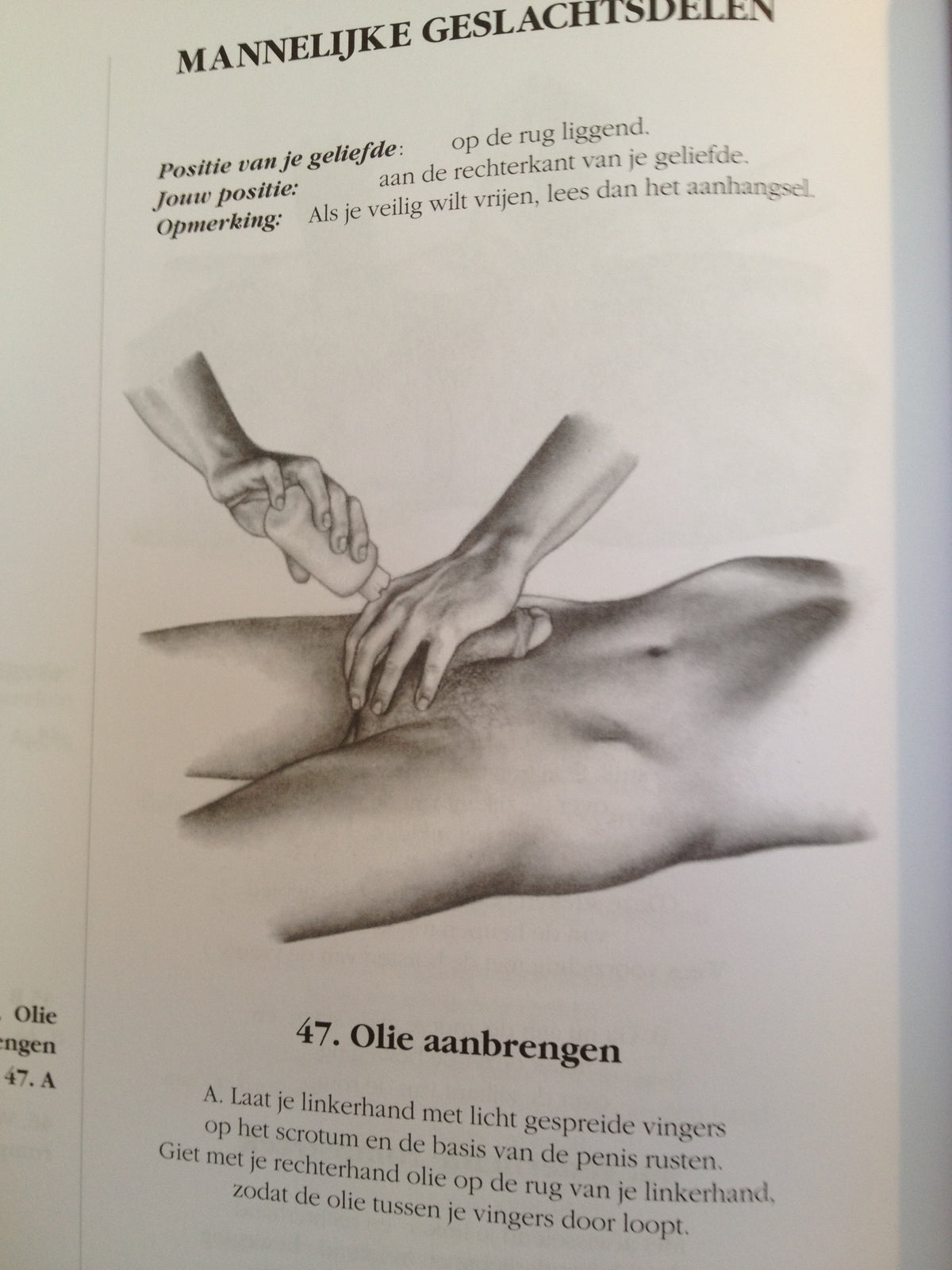
Start with the back and shoulders, using long, calm strokes, and keep one hand in contact. The whole body can be included; breasts and genitals only if you have agreed on that beforehand. What to have to hand is listed in what you need for a massage together; how to give an erotic massage can be found in learning erotic massage.

Relaxing together with caressing exercises: five exercises with drawings

Caressing is the loveliest relaxation exercise for two that we know: nothing is required, a lot is allowed, and you get to know each other's bodies all over again without it having to lead anywhere. Sexologists have had couples doing it for half a century, and at home you simply do it in bed. Five exercises, each with a drawing; do one per evening, or do them one after the other if you have an hour.

From our blog

Sensate Focus: the full programme in four phases

These five exercises are a beginning. In sex therapy they are called Sensate Focus, and there they form a programme of a few weeks: first caressing without breasts and genitals, then with, and only at the end making love again.

Our blog on caressing exercises covers all four phases, with a caressing plan that tells you what to do this week.

Read the caressing exercises

The ground rules. Take turns: one of you caresses, the other receives, and after five to ten minutes you swap. No talking while caressing, but do talk afterwards. Breasts and genitals stay out of the picture in these five exercises, and making love is off the table tonight, even if you start to feel like it: that very agreement is what takes the pressure off. Beyond that: a warm room, a towel, and a little oil if you enjoy it.

In the drawings she is dark purple and he is lilac; simply swap who caresses and who receives. The pink lines show the movement.

Drawing: a woman lies on her stomach while her partner caresses her in one long line from shoulders to feet

1The back, from shoulders to feet

How to do it. The one receiving lies on their stomach, head resting on the arms. The other caresses with the whole hand from the shoulders, down the back to the buttocks, the legs and the feet, and back again. Slowly, alternating between very light and somewhat firmer. After five to ten minutes you swap roles.

What to pay attention to. The one caressing pays attention to what the hand feels: warm, soft, rough, hair, skin. The one receiving notices where it feels good and where it does not, without having to say anything. If your thoughts wander, calmly bring them back to the hand.

  • Five to ten minutes each
  • Taking turns
  • Lying on the stomach
Drawing: a man and a woman sit facing each other, he strokes her cheek with one hand

2Face, hands and arms

How to do it. Sit facing each other. The one receiving closes their eyes. The other caresses the face with the fingertips: the forehead, the temples, the cheeks, the jaw. Then the neck, the hands and the arms. A few minutes, and then swap.

What to pay attention to. This is the exercise for anyone who finds it all a bit daunting: everything can be done fully clothed, and yet it is surprisingly intimate. A smile or a fit of the giggles is part of it; afterwards, simply start again.

  • A few minutes each
  • Taking turns
  • Sitting, clothes on
Drawing: a woman lies on her back with a towel over her hips, her partner kneels beside her and caresses her

3The front, without breasts and genitals

How to do it. The one receiving lies on their back; a towel over the hips is fine. The other caresses the feet, the legs, the belly, the arms, the shoulders and the neck, but not the breasts and not the genitals. Vary the pressure and try something other than your hand: the backs of your fingers, a soft feather, a warm palm.

What to pay attention to. The one receiving notices what the touch does to the body: relaxation, tingling, perhaps desire. You do not have to do anything with it. Precisely because nothing is required, the tension can ease.

  • Five to ten minutes each
  • Taking turns
  • Lying on the back
Drawing: a woman places her hand on her partner's hand and guides it along her arm

4Guided caressing: saying what you enjoy

How to do it. The same exercise as above, but now the one receiving leads: place your hand on your partner's hand and show where and how you like it. Slower, softer, here yes and there not. A word is fine too: “Here, a little softer.” Then swap.

What to pay attention to. This way you learn to say what you enjoy without a whole conversation. Many people rarely say it out loud; with a hand on top, it happens almost by itself.

  • Five minutes each
  • Taking turns
  • Sitting or lying down
Drawing: a man and a woman sit facing each other and caress each other's arms at the same time, with two little hearts above them: caressing together

5Caressing together, and talking afterwards

How to do it. Sit facing each other and caress each other at the same time: the arms, the back, the neck, the face. Pay attention to what you give and to what you feel, both at once. Afterwards, stay close for a while under a blanket and ask each other: what felt good, what would you rather skip, and when shall we do this again?

What to pay attention to. Talking afterwards is part of it every time, but not during the caressing. Phrase what you enjoyed less as a wish: “I love it when you stroke my legs, but I'd rather you left out my groin.”

  • Ten minutes
  • Together
  • Then under a blanket

Would you like to turn this into a programme, step by step, later including the breasts and genitals and eventually making love again? That is the four-phase programme from our blog on caressing exercises (sensate focus), with a caressing plan that moves along with you. If making love is painful, also read pain during sex; if his erection lets him down just when it matters, our blog on erectile dysfunction with a psychological cause can help.

What you need for a massage together

You need very little for a massage: a warm room, a towel and something that lets your hands glide easily. We picked three things from our range that we are happy to recommend, plus the book below for anyone who really wants to learn the art.

Slowmass Natural Oil Massage

Our choice if you would like to bring out a toy after the massage

An unscented massage oil made from seven plant oils, from our own brand House of Delight, that spreads well and keeps gliding for a long time. It contains sweet almond oil and sesame oil. According to the manufacturer it does not damage silicone toys; we did not want to simply take that for granted and ran a number of tests ourselves. We, too, saw no damage to the silicone and no faltering electronics. Do clean the toy after every use with water and a mild soap, and do not use the oil with toys that have holes, seams or openings you cannot clean properly. For internal use, a lubricant is more suitable than oil.

View Slowmass Natural Oil Massage

Massage Olie Red Orange by Bodygliss

For anyone who would rather not shower afterwards

A silicone-based massage oil with a warm scent of blood orange. Four testers rated this oil for us, with scores from 7.5 to 9 out of 10. All four mentioned the scent and the silky feel on the skin, as well as the fact that the oil does not leave a sticky residue. Do not use it with silicone toys, as it damages them.

View Massage Olie Red Orange by Bodygliss

Bodygliss Ignite the Night, massage candle

Atmosphere and warm oil in one

A candle that melts into warm massage oil, with a scent of chai and blood orange. Light it fifteen to twenty minutes beforehand, blow out the flame and first test on the inside of your arm whether the oil feels pleasantly warm. It contains almond oil, so do not use it if you have a nut allergy, and not together with latex condoms or silicone toys.

View Bodygliss Ignite the Night

Oil and latex do not mix: oil breaks down a latex condom. If you want to be sure, choose a water-based lubricant with latex condoms; the Dutch GP guidelines warn that silicone-based lubricant can also damage latex.

You will find all massage oils, massage candles and other things to enjoy together in our sensual massage collection. How to give an erotic massage is explained in learning erotic massage, and help with choosing an oil in our massage oil buying guide.

Which exercise suits you, and how often?

There is no exercise that works best for everyone. Try a few until you find one that suits you. One person gets the most out of counting, another out of picturing a beach.

ExerciseSuits you ifHow long and how often
Belly breathingyou want to calm down quickly, wherever you areat least 5 minutes.
4-7-8 breathingcounting helps you clear your head, also when falling asleep4 rounds, twice a day.
Muscle relaxation (Jacobson)you feel the tension mainly in your musclesa few seconds of tension per body part; skip any painful spot.
Guided imagerytensing your muscles causes cramp or other discomfort10 to 20 minutes.
Mindfulnessyour head is full, or there is anxiety around sexat a set time, for example during a walk; during sex, keep returning briefly to what you feel.
Yogayou like to move while relaxingas long as it feels good.
Caressing or massaging each otheryou want to relax togethertaking turns, for example 5 minutes each.

Some health websites recommend practising for half an hour two or three times a day. That is a lot, and who can keep that up? Our advice: start with what you can manage, and do a little every day rather than a lot now and then. And do not expect much straight away. The difference often feels small at first and becomes clearer over time.

Learn an exercise at a calm moment first, not in the middle of a tense situation. That way you can focus on the technique. Once you know it well, you can use it wherever and whenever you need it, in bed too. A reminder helps: a coloured dot on your watch or a fixed spot in your home that reminds you to drop your shoulders and pay attention to your breathing.

Stop if an exercise hurts or feels uncomfortable. Do not look at the clock while practising. And do not worry about relaxing too deeply: that is not possible.

When should you see your GP?

You can do relaxation exercises on your own. Do see your GP in the following cases:

  • Sex hurts, and the pain does not go away. Sex should not hurt.
  • You have had little desire for sex for some time, and it bothers you.
  • Your erections are less firm, or you keep climaxing sooner than you would like.
  • Symptoms appear suddenly.
  • You have a lung condition or another breathing problem, and you want to do breathing exercises.
  • Tension or panic dominates your daily life, or you can no longer take proper care of yourself.

If you have pain, the GP will first check whether there is a physical cause, such as an infection or a skin condition. A speculum is not needed for this: the GP examines the vagina and the pelvic floor from the outside. If you would prefer to be examined by a woman, ask for this when making the appointment. With erection problems, the GP will work out with you what the cause might be and what helps.

When does it make sense to get more help?

Does the tension not ease, even after a few weeks of practice, or do fear, distressing experiences (such as coercion or sexual abuse) or pelvic floor problems play a part? Then it makes sense to get help from someone else. To learn to relax, you can turn to a practice nurse at your family doctor's, a psychologist, a movement therapist, a haptotherapist or a physiotherapist. Sometimes your family doctor needs to refer you, sometimes you can make an appointment yourself. Your local municipality or a home care organisation near you may also offer a course.

For sexual problems, your family doctor can refer you to a sexologist (registered with the national professional association) or to a physiotherapist who specialises in the pelvic floor. For vaginismus, treatment combines relaxation exercises with gradually, step by step, getting used to a finger or a dilator in the vagina; you can read more about this in what is vaginismus. The pelvic floor and pain during sex are covered in pelvic floor and pain during sex.

A parting word from the Empress

Simply start tonight, with five minutes of belly breathing side by side in bed with the lights off. No plan, and no expectation that anything has to happen afterwards. There is a good chance you will both drift off into a lovely sleep, and that is a perfectly fine outcome too. And if it turns into something else after all, we wish you a great deal of pleasure.

Frequently asked questions

Answers to your questionsClickTap a question to see the answer
Which relaxation exercises are most effective for better sex?

No single exercise works best for everyone, so try a few until you find one that suits you. Slow breathing (belly breathing or 4-7-8 breathing) and Jacobson's muscle relaxation can reduce tension and anxiety. If tensing your muscles gives you cramp, guided imagery is a better fit. And if anxiety around sex plays a part, mindfulness can also help women.

How does the 4-7-8 breathing exercise work?

First breathe out through your mouth. Then breathe in through your nose for a count of 4, hold your breath for a count of 7 and breathe out slowly through your mouth for a count of 8, making a soft whooshing sound. Do four rounds, twice a day. It is a form of slow breathing, and that can help you relax. If you feel light-headed, stop and simply breathe normally.

When should you do relaxation exercises before sex?

First learn an exercise at a quiet moment, ideally every day. Once you know it well, you can use it before making love, together during foreplay, and in between whenever you notice you are getting tense. During lovemaking itself, we recommend calm belly breathing rather than 4-7-8 breathing.

What is the Jacobson method (PMR) and how does it help with sex?

With the Jacobson method, or progressive muscle relaxation, you tense your muscles one by one and release them as you breathe out. This teaches you to feel the difference between tension and relaxation. It can reduce stress and anxiety. Do it before making love so that you start out relaxed: being relaxed is an important condition for making love without pain.

Can yoga exercises help with sexual tension?

Perhaps a little. Yoga combines postures with slow breathing and has been linked to a small improvement in how things go in bed, but that is not yet certain. Child's pose is a simple position to relax in. The frequent claim that child's pose and happy baby relax the pelvic floor is not something we found supported by evidence.

How often should you do relaxation exercises?

Ideally every day, because that is how you get better at them. Do belly breathing for at least five minutes, and 4-7-8 breathing for four rounds, twice a day. Don't expect too much straight away: the difference often feels small at first and becomes clearer over time.

Can partners do relaxation exercises together?

Yes, and we warmly encourage it. You can lie side by side and breathe slowly together, follow a recording of the muscle relaxation together, or take turns caressing or massaging each other, for example five minutes each. If you use massage oil, don't combine it with a latex condom: oil damages latex.

Do relaxation exercises also help with fear of pain during sex?

They can help. Fear of pain makes the pelvic floor muscles tense up and makes it harder to become aroused, and then making love is more likely to hurt. Relaxation is one of the things that help break that cycle. Mindfulness reduced anxiety around sex in women; whether it also reduces the pain itself is not yet clear. If making love hurts, don't force anything, and see your doctor if the pain persists.

How do you do belly breathing?

Sit or lie down, cup your hands over your belly and breathe in calmly through your nose and out through your mouth, as deep into your belly as feels comfortable. If you like, count to 4 as you breathe in and to 6 as you breathe out. Keep it up for at least five minutes and then stay seated for a little while. The breathing timer on this page counts along with you.

Do relaxation exercises help with stress-related erection problems?

They can help if tension or performance anxiety is getting in the way of an erection: if you breathe calmly and keep your attention on what you feel rather than on whether it will work, you become aroused more easily. The caressing exercises take the pressure off together. If it works when you are on your own or in the morning but not with your partner, the cause is usually psychological. If the problem persists, see your doctor, because erection problems can also have a physical cause.

Which relaxation exercise can you do together?

Breathing together: lie side by side, place a hand on each other's belly and breathe in the same rhythm for a few minutes. Then the caressing exercises: take turns caressing each other while avoiding breasts and genitals, five to ten minutes each, with no lovemaking afterwards. Or a massage, in a warm room with a little oil. The relaxation programme on this page lays out an evening like this for you step by step.

Sources and accountability

Based on the sources below and our product pages. Where little is known about an exercise, the text says so. This article is not medical advice: if sex is painful, or if the tension does not go away, please see your doctor.

  1. Nederlands Huisartsen Genootschap (Dutch College of General Practitioners). NHG guideline on sexual problems (M87). Last updated 2023. view source
  2. Thuisarts.nl (NHG). I want to be able to relax better. view source
  3. Thuisarts.nl (NHG). I have pain during sex (women). view source
  4. Thuisarts.nl (NHG). Stroking and massaging each other (not the penis, vagina, anus and breasts). view source
  5. Thuisarts.nl (NHG). My penis is getting less firm. view source
  6. Rutgers, Seksualiteit.nl. Relaxation exercise. view source
  7. Rutgers, Seksualiteit.nl. Pain during sex. view source
  8. GGZ Drenthe. Relaxation exercises (recordings of the muscle relaxation and a guided visualisation). view source
  9. Mentaal Vitaal (Trimbos Institute). Relax: exercises and podcast. view source
  10. Fincham GW, Strauss C, Montero-Marin J, Cavanagh K (2023). Effect of breathwork on stress and mental health: a meta-analysis of randomised-controlled trials. Scientific Reports. view source
  11. Laborde S et al. (2022). Effects of voluntary slow breathing on heart rate and heart rate variability: a systematic review and a meta-analysis. Neuroscience and Biobehavioral Reviews. view source
  12. Muhammad Khir S, Wan Mohd Yunus WMA, Mahmud N et al. (2024). Efficacy of progressive muscle relaxation in adults for stress, anxiety, and depression: a systematic review. Psychology Research and Behavior Management. view source
  13. Brotto LA et al. (2021). A randomized trial comparing group mindfulness-based cognitive therapy with group supportive sex education for female sexual interest/arousal disorder. Journal of Consulting and Clinical Psychology. view source
  14. Thomas HN, Brotto LA et al. (2023). A virtual group-based mindfulness intervention for midlife and older women with low libido. Journal of Sexual Medicine. view source
  15. Rodrigues AMBP, Neto OB, Seguro CS et al. (2024). Does yoga improve sexual function? A systematic review and meta-analysis of randomized clinical trials. Complementary Therapies in Clinical Practice. view source

Last updated on 5 November 2026.

Leave a comment

Note: Comments must be approved before they are published.